
Zero is far more than a simple digit. It is among the best concepts that have ever been invented by the human mind. Since simple counting to complex space exploration and modern computing primeval zero takes centre stage in our perception of numbers, reason and the cosmos in general. However, the discovery of zero was not a one-time event in history, but a slow intellectual discovery, which was influenced by the whole civilizations and ancient India was its centre.
This article explores the origin of zero, the mathematicians behind its development, and how it evolved into the indispensable number we rely on today.
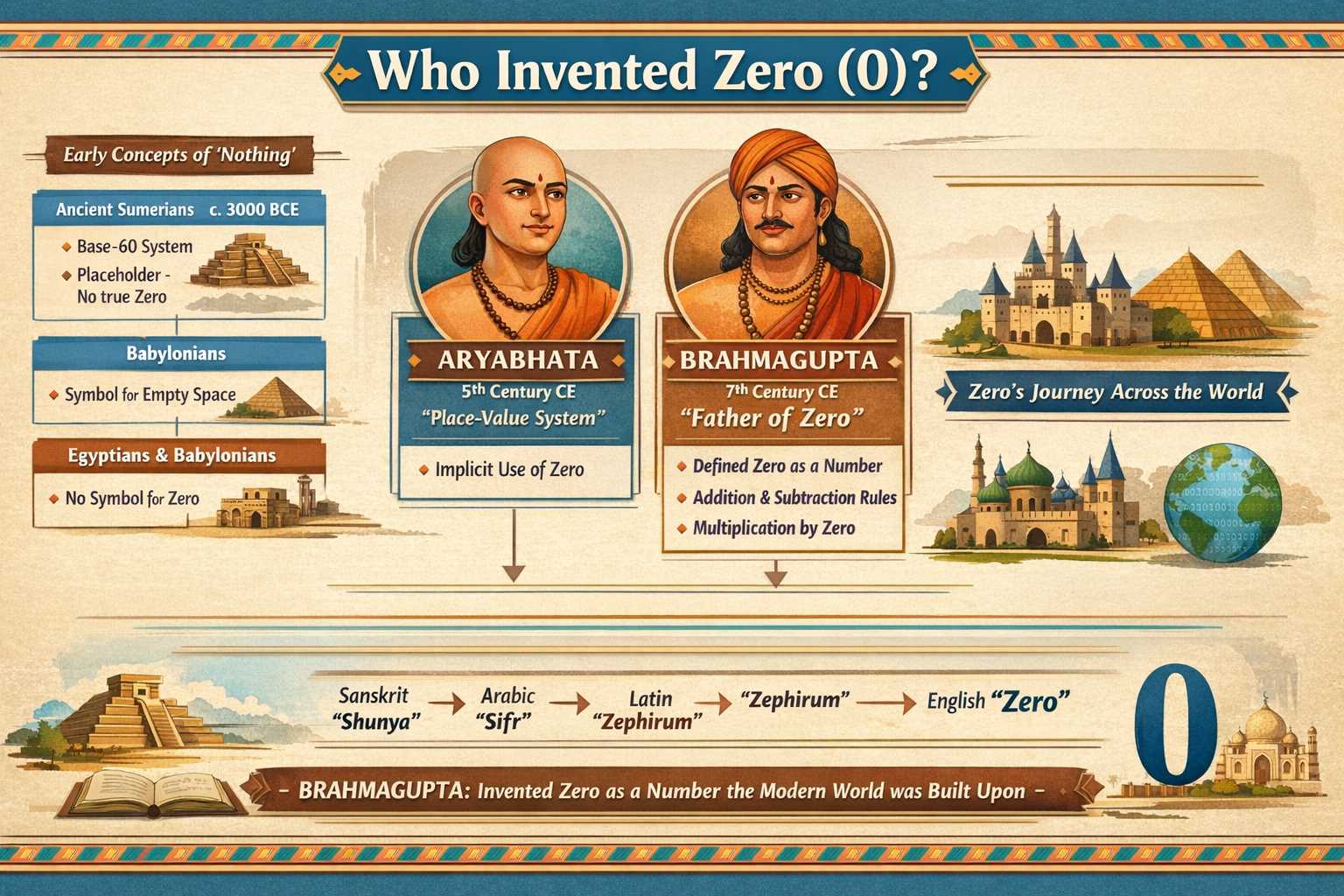
What Is Zero?
Zero is a singular figure which is used to depict nothingness or lack of quantity. Contrary to other numbers that depict the quantity of something that is in existence, zero depicts that nothing exists. Notwithstanding this (similar) simplicity, zero is fundamental to:
-
Place-value number systems
-
Arithmetic operations
-
Algebra and calculus
-
Digital technology and Computer science
There would be no modern mathematics and science without zero.
Early Understanding of Zero Across Civilisations
For a long time ago, the formal concept of zero, the ancient cultures had been familiar with the concept of nothing, but they had different ways of conveying it.
Egyptians and Babylonians
-
Realised the idea of absence.
-
Did not take a special symbol of zero.
-
Used context or whites to indicate the missing values.
Sumerians (c. 3000 BCE)
-
Used a base-60 (sexagesimal) number system
-
Employed placeholders to show missing positions
-
Did not treat zero as an independent number
Babylonians
-
Enhanced the concept of the placeholders.
-
Still had not specified the definition of zero as an arithmetic number.
-
Indicated an empty place with a symbol.
These early systems laid the groundwork but stopped short of creating zero as a true mathematical entity.
Who Invented Zero (0)?
The modern concept of zero—as both a symbol and a number that can be calculated—was developed in ancient India by the two famous mathematicians:
-
Aryabhata (5th century CE)
-
Brahmagupta (7th century CE)
Though the place-value system was introduced by Aryabhata, Brahmagupta provided zero with its mathematical identity.
What are the Aryabhata’s Contribution to Zero?
Aryabhata (476–550 CE) was one of India’s greatest mathematicians and astronomers. In his famous work Aryabhatiya, he:
-
Applied a place-value decimal system
-
Unconsciously, the concept of zero was in use
-
Advanced trigonometry and algebra
-
Calculated the accurate values of π
-
Explained the Rotation of the Earth on its axis
Even though Aryabhata never specially defined the concept of zero, his contribution provided the context in which the concept of zero could serve a useful purpose.
Who is the Father of Zero in Mathematics?
Brahmagupta: The Father of Zero in Mathematics
Brahmagupta (598-668 CE) is generally considered the first mathematician to define zero and he is considered as the father of Zero in Mathematics.
In his masterpiece book, Brahmasphutasiddhanta, he:
-
Treated zero as a number
-
Established rules for:
-
Addition with zero
-
Subtraction with zero
-
Multiplication by zero
-
Negative numbers explained as well as zero.
This is the earliest in history that the zero was provided with explicit arithmetic regulations and hence the contribution of Brahmagupta was revolutionary.
His place of work was subsequently registered at the Chaturbhuj Temple at Gwalior which gives physical testimony to the early usage of zero.
Who Invented the Zero Number?
Brahmagupta invented the concept of zero number as it is known to us today. He pioneered the addition of zero to mathematical operations by moving past using placeholders.
Who Invented the Concept of Zero?
The idea of zero developed over a long period, although it became fully mathematical in India. Whereas the previous civilisations knew of nothing, the Indian mathematicians turned it into a number that could operate.
Who Invented Zero in India?
India is the birthplace of zero as a mathematical number.
| Mathematician | Contribution |
| Aryabhata | Place-value system (implicit zero) |
| Brahmagupta | Arithmetic rules for zero |
Together, they shaped zero into a usable mathematical tool.
Who Invented Zero in the World?
Globally, zero originated in ancient India and later spread to:
-
The Islamic world, where scholars translated Indian texts
-
Europe, through Arabic mathematical works
-
Eventually, the entire modern world
This transmission reshaped global mathematics forever.
Who Invented the Name “Zero”?
The word “zero” has an interesting linguistic journey:
-
Sanskrit concept → Arabic “sifr” (meaning empty)
-
Latin “zephirum”
-
Italian “zero”
-
English “zero”
While Indian scholars developed the concept, the modern name evolved through cultural exchange.
Who Invented Zero in Mathematics?
Brahmagupta is known to have invented the number zero in mathematical history. His definitions enabled zero to serve in arithmetic, algebra, and, after that the developed mathematics.
Brahmagupta or Aryabhata: Who Invented Zero?
Both played vital roles, but their contributions differed:
-
Aryabhata: Introduced place-value thinking
-
Brahmagupta: Defined zero mathematically
Final Verdict:
Brahmagupta invented zero as a number, while Aryabhata laid the foundation.

Conclusion
One of the most important intellectual accomplishments of humanity is zero. Notions of nothing may have existed in many ancient civilisations, but it was the Indian mathematicians (and Brahmagupta in particular) who changed zero into an impressive mathematical instrument. Since ancient manuscripts and modern computers, zero has defined the way we compute, develop, and cognise the universe.



-1766159625283.jpg)
-1766128662526.jpg)

Comments
All Comments (0)
Join the conversation