In India, there is a vast culture and a diverse regional range based on ethical, cultural, and social interaction rather than on ease or prosperity, but what about the area-wise location of the districts of India?
In India, there are around 780-800 districts, which are also called “Zila”.
It is a primary administrative unit within an Indian state or Union Territory, which is headed by the District Magistrate/Collector, who is responsible for implementing government policies, law & order, and revenue management.
Everyone is familiar with the“Kutch”, which is the largest district in India, and you will be surprised to know that the top 3 largest districts of India are located in Rajasthan only
But, do you often know which is the Smallest District in India?
In which state is this the smallest district?
So, let’s explore this article in detail and come to know about the Smallest District in India.
Which is the Smallest District in India?
The Smallest District in India is Mahe, also known locally as “Mayyazhi”.
Mahe is one of the four districts of the Union Territory of Puducherry, which stands out from the others due to its tiny area and unique geographical location.
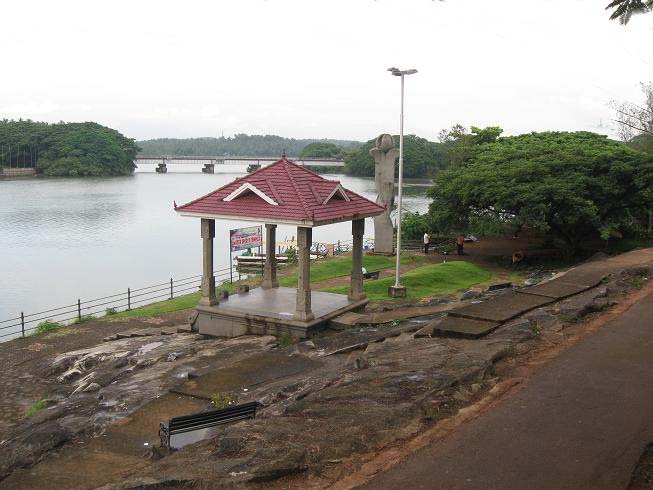
Source: mahe.gov
Where is the Mahe District located?
Mahe District is located at the mouth of the Mahe (Mayyazhi) River, where it meets the Arabian Sea.
Mahe district is also titled as “Eyebrow of the Arabian Sea”
It is bordered by:
-
Three sides of Kannur district
-
One side by Kozhikode district
This strategic coastal position has historically made Mahe an important trade and cultural point.
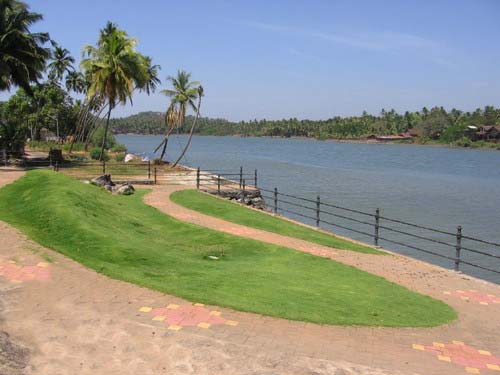
Source: mahe.gov
What is the historical background of Mahe?
Mahe was once part of French India, and its colonial past is still visible in its local architecture, street layout and in its cultural traditions.
After 1947, when India gained independence, the Mahe district became an integral part of the Union Territory of Puducherry.
Today, Mahe is functioning as:
-
As a municipality
-
As a full-fledged district
-
As a legislative constituency with one representative in the Puducherry Legislative Assembly
District Mahe – Overview
| Category | Particulars | Details |
| General Information | Area | 9 sq. km |
| Geographical Area | 868.76 hectare | |
| Latitude | 11°42′ to 11°43′ North | |
| Longitude | 75°31′ to 75°33′ East | |
| Temperature | 19°C to 36°C | |
| Average Rainfall | 3000 mm | |
| Rainy Season | June–August (South-West Monsoon)September (North-East Monsoon) | |
| Administrative Units | Tehsils | 1 (Mahe) |
| Blocks | 1 (Mahe) | |
| Villages | 5 | |
| Population (Census 2011) | Male Population | 19,269 |
| Female Population | 22,665 | |
| Total Population | 41,934 | |
| Sex Ratio | 1176 | |
| Literates | 36,730 | |
| Literacy Rate | 98.35% | |
| Agriculture | Major Crops | Coconut, Banana, Tapioca, Arecanut, Pepper, Jackfruit, Mango |
| Cropping System | Tier & Mixed |
Data Source:mahe.gov.in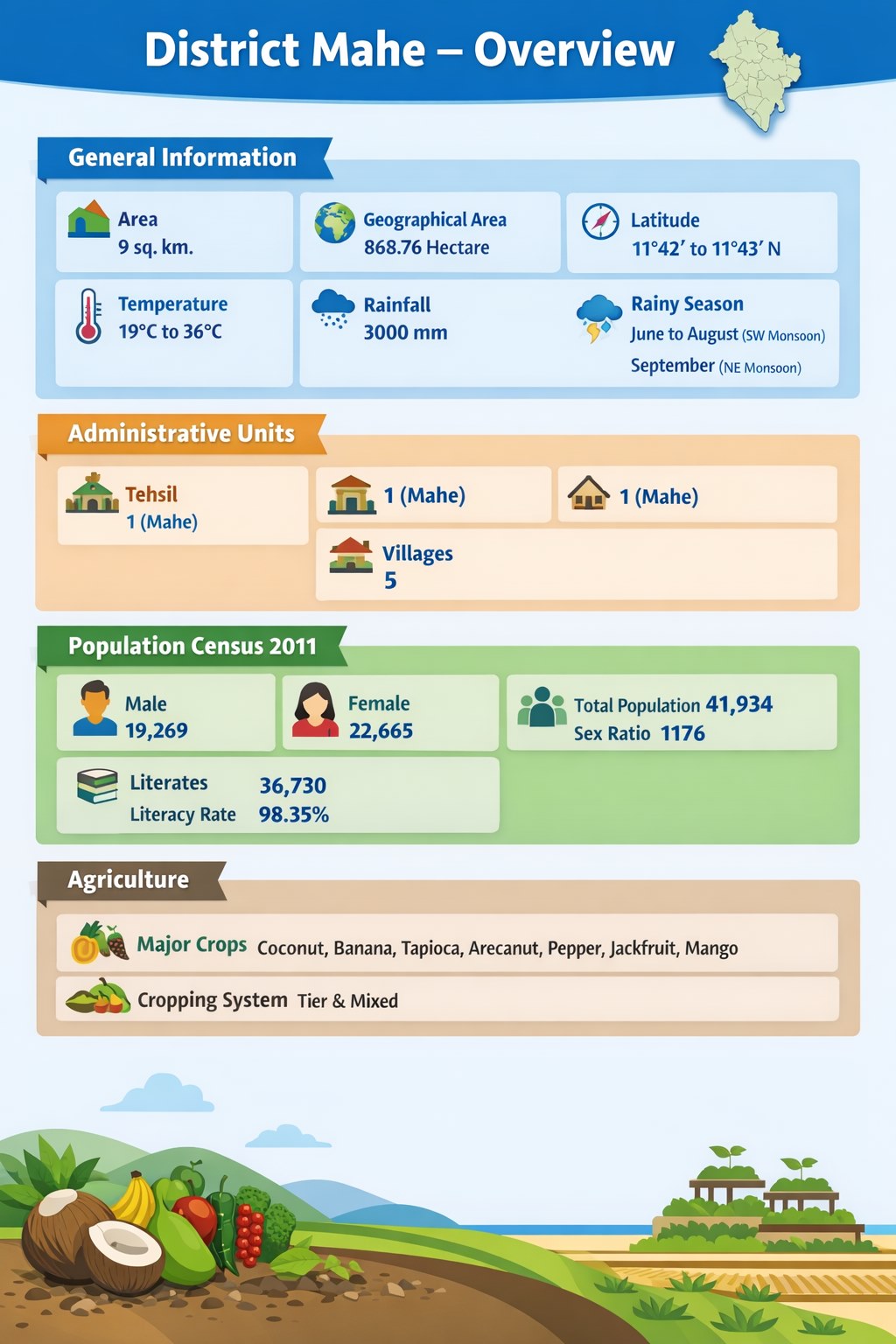
Conclusion
Mahe is the Smallest District in India, which is known locally as “Mayyazhi”. Its administrative importance is not measured by land area alone, but also, Mahe carries a rich historical legacy, strategic coastal value, and cultural depth that far outweigh its size.
In India, Mahe stand as a reminder that even the smallest region can hold great significance in politically, economically, and historically.



-1767073462439.jpg)
-1768241794469.jpg)
-1768222025659.jpg)
Comments
All Comments (0)
Join the conversation