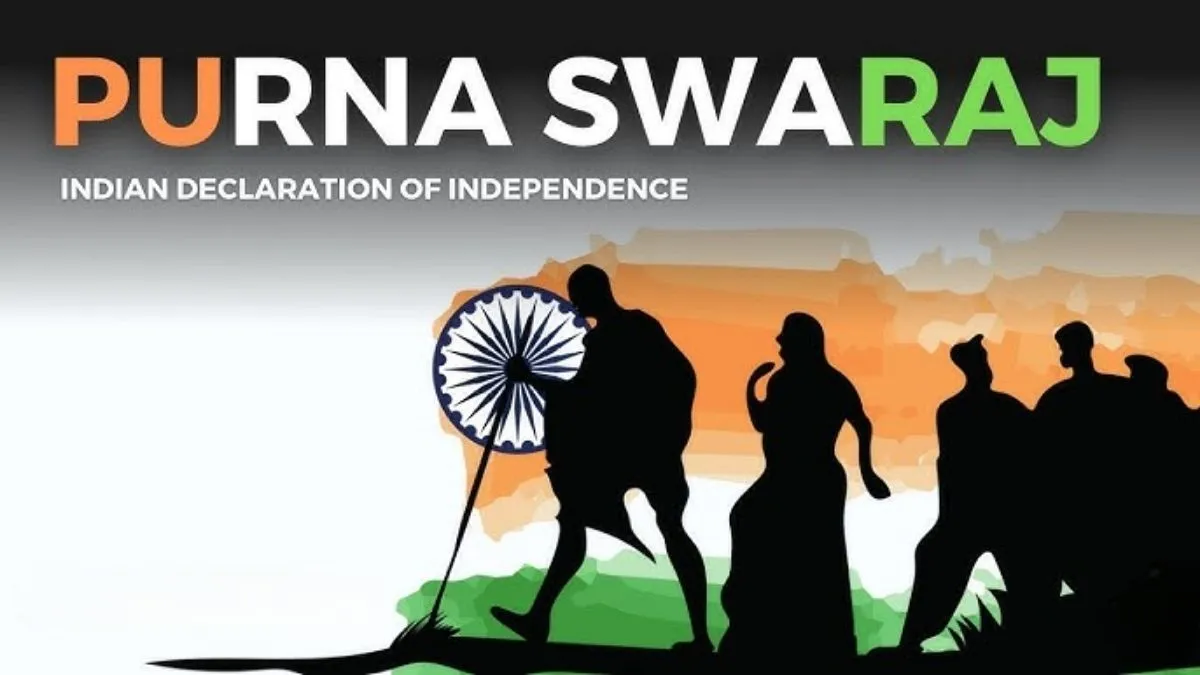
The Lahore Declaration of December 1929 marked a decisive psychological and political shift in India’s freedom struggle.
This was a turning point in the objective of the national movement, long before we got independence in August 1947.
On the Ravi banks, the tricolour was raised, and the cry of Purna Swaraj (full independence) was given out as a right, and not a concession.
The Indian National Congress publicly discarded all half steps under the leadership of Jawaharlal Nehru with the colonial rule. This speech turned the freedom into something that was far but not negotiable, something that was going to be achieved nationally.
What was the Lahore Declaration of 1929?
The Indian National Congress, on December 19, 1929, passed the historic resolution, “Purna Swaraj” at the Lahore Session, and the Congress stated that:
-
The objective of the Indian people was complete independence.
-
Any connection with Britain in the constitution must be broken.
-
The cause of freedom was to now encompass civil disobedience, non- co- operation as well as economic self-reliance via Swadeshi.
What was the significance of the Lahore Congress Session in 1929?
The Lahore session of the Indian National Congress in 1929 was a pivotal moment in the Indian movement because, under this Congress Session, it was formally declared that “Purna Swaraj” (Complete Independence) was the goal of the Indian National Congress, replacing the previous demand of dominion status.
These are the various significances of the Lahore Congress Session in 1929, which are:
-
Declaration of Purna Swaraj
-
Authorisation of the Civil Disobedience Movement
-
Boycott of the Round Table Conference
-
First Independence Day
-
Symbolic Flag Hoisting
-
Resignation from Legislatures
Who led the Lahore session in 1929?
Jawaharlal Nehru, the President of the 1929 session of the Indian National Congress, led the Lahore session.
Why did the Idea of Purna Swaraj become necessary by the Late 1920s?
By the end of the 1920s, faith in gradual constitutional reform had collapsed.
Two forces—economic hardship and political humiliation—combined to push the nationalist movement toward a more radical demand.
How the did the economy of India affects toward the approaches of Purna Swaraj?
In the 1920s, the economy of India affects toward the approaches of Purna Swaraj in many ways, such as:
-
The agrarian economy of India was destroyed by the global economic recession.
-
The prices of major crops like cotton, jute, and wheat went down, and the demand for land revenue was also inflexible.
-
The peasants were subjected to increasing debt, loss of land and social disorder.
Many Indian scholars, like Dadabhai Naoroji’s Poverty and Un-British Rule in India (1901), proved by meticulous statistics how British policies systematically transferred wealth from India to Britain. R.C. Dutt, in The Economic History of India (1902), examined how the land revenue system, like the Permanent Settlement, ruined the rural economy of India.
What are political landscape toward the approaches of Purna Swaraj?
There were variouspolitical turmoil in the 1920s, which included:
-
The appointment of the Simon Commission (1927) without a single Indian member deeply offended national sentiment.
-
The country was shaken with nationwide demonstrations, black flags, and the motto of “Simon Go Back”.
What Was the Debate Between Dominion Status and Complete Independence?
Indian politics during this period revolved around two contrasting visions of freedom:
| Aspect | Dominion Status | PurnaSwaraj |
| Nature | Self-rule within the British Empire | Full political sovereignty |
| Support Base | Older, moderate leadership | Younger, radical nationalists |
| Limitation | Continued allegiance to Britain | Total break from colonial rule |
Leaders like Motilal Nehru initially viewed dominion status as a practical step forward. However, younger voices such as Jawaharlal Nehru and Subhas Chandra Bose rejected it as a symbolic compromise that diluted India’s sovereignty.
How did British Policy define India’s Dominion Status??
After the British Labour government came to power, Lord Irwin, then Viceroy of India, on 31 October 1929, stated the dominion status for India, and Lord Irwin said that, “The Nehru Report, 1928, ‘1. India shall have the same constitutional status in the community of nations, known as the British Empire, as the Dominion of Canada, the Commonwealth of Australia…’.
While demands for dominion status were made by some Indians during the first two decades of the 20th century, it was only after the passing of the Government of India Act 1919 that this demand became a common and forceful part of the vocabulary of the Indian political class.” along with promises of future Round Table Conferences, was widely seen as a delaying tactic.
For Indian nationalists, this confirmed that colonial reforms were designed to postpone real power transfer rather than enable it.
How Did the Purna Swaraj Shape Future National Movements?
The declaration was not merely symbolic.
It gave Mahatma Gandhi the right to start the Civil Disobedience Movement and urged Indians to struggle against unjust laws, exploitation by the colonialist and domination of the culture.
Its influence went far past the 1930s.
At the time of adopting the Constitution of India, it was specifically PurnaSwaraj and the date on which the first Purna Swaraj was publicly celebrated and was selected as 26 January and that's why 26 january is chosen as Republic Day.
Why is the Purna Swaraj Considered a Turning Point in Indian History?
Across ideological interpretations—nationalist, Marxist, or subaltern—one conclusion remains consistent: the Lahore Declaration unified the freedom struggle around an unambiguous objective.
Independence was no longer a favour to be negotiated but a right to be claimed.
Conclusion
The Purna Swaraj, which was demanded in the Lahore Declaration of 1929, stands as a defining milestone in India’s journey to freedom.
It enhanced independence as a way of carrying out far-off aspirations into a group determination, redefined political strategy and formed the ethical fiction of the whole population opposing.
These events of August 1947 would have had no ideological grounding without this ambitious statement of Purna Swara.





Comments
All Comments (0)
Join the conversation