What are the 5 Layers of the Atmosphere?
Earth is our home. We live on the surface of the Earth. Do you know that the planet Earth initially was a barren, rocky, and hot object with a thin atmosphere of hydrogen and helium? Far from the present-day picture of the earth, right? Let's learn about the evolution of the atmosphere and its five layers that blanket the earth.
Earth is our home. We live on the surface of the Earth. Do you know that the planet Earth initially was a barren, rocky, and hot object with a thin atmosphere of hydrogen and helium? Far from the present-day picture of the earth, right? The present-day composition of earth's atmosphere is primarily oxygen and nitrogen.
Evolution of the Earth's Atmosphere
The earth has a layered structure. There were three stages in the evolution of the present atmosphere. The loss of the primordial atmosphere was the first stage. Contribution of the hot interior of the earth marked the second stage of the evolution of the atmosphere. And finally, the process of photosynthesis changed the composition of the atmosphere.
Solar winds resulted in the stripping of the early primordial atmosphere of hydrogen and helium. Degassing from the Earth's interior flooded the early atmosphere largely with water vapour, nitrogen, carbon dioxide, methane, ammonia, and very little oxygen.
As the earth cooled, the water vapour started getting condensed. Large amounts of carbon dioxide got dissolved in rainwater, which got collected in depressions giving rise to oceans. Around 3,800 million years ago, life began to evolve. And around 2,500 to 3,000 million years ago, the process of photosynthesis evolved.
Did you know? The earth's oceans were formed within 500 million years from the formation of the earth.
Importance of Earth's Atmosphere
And that's how the atmosphere of the Earth that we see today came to be. The atmosphere plays a crucial role in protecting the life on the Earth. It is a blanket for the planet.
(i) The atmosphere absorbs the incoming solar radiation. The ozone layer blocks the harmful UV rays. Clouds and other gases also absorb some sunlight.
(ii) The atmosphere traps the outgoing heat. Without it, the Earth would be too cold for life to exist. The structure of the atmosphere is important to gain insights into weather patterns.
NOTE: However, excess carbon dioxide from human activities can accentuate the greenhouse effect, casuing global warming.
What are the 5 Layers of the Atmosphere?
The huge blanket of air surrounding the earth is called the atmosphere. The Earth's atmosphere comprises of layers. The atmosphere is primarily consists of nitrogen (78 per cent) and oxygen (21 per cent) along with small amounts of carbon dioxide, water vapour, argon, and other gases.
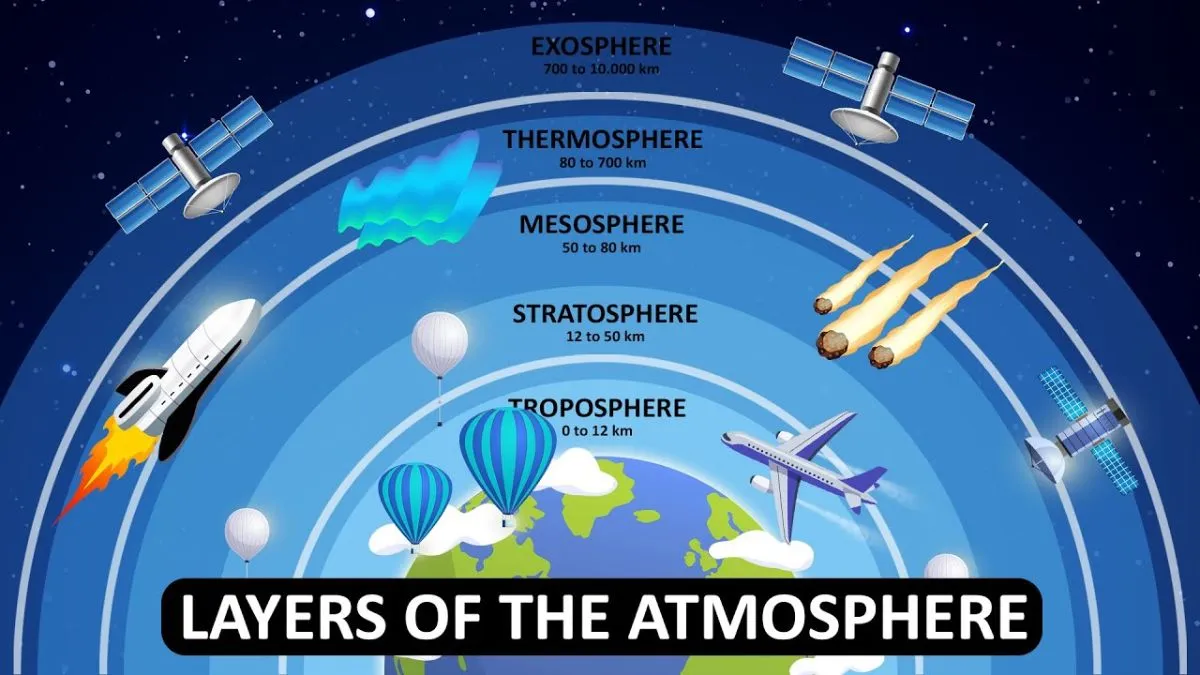
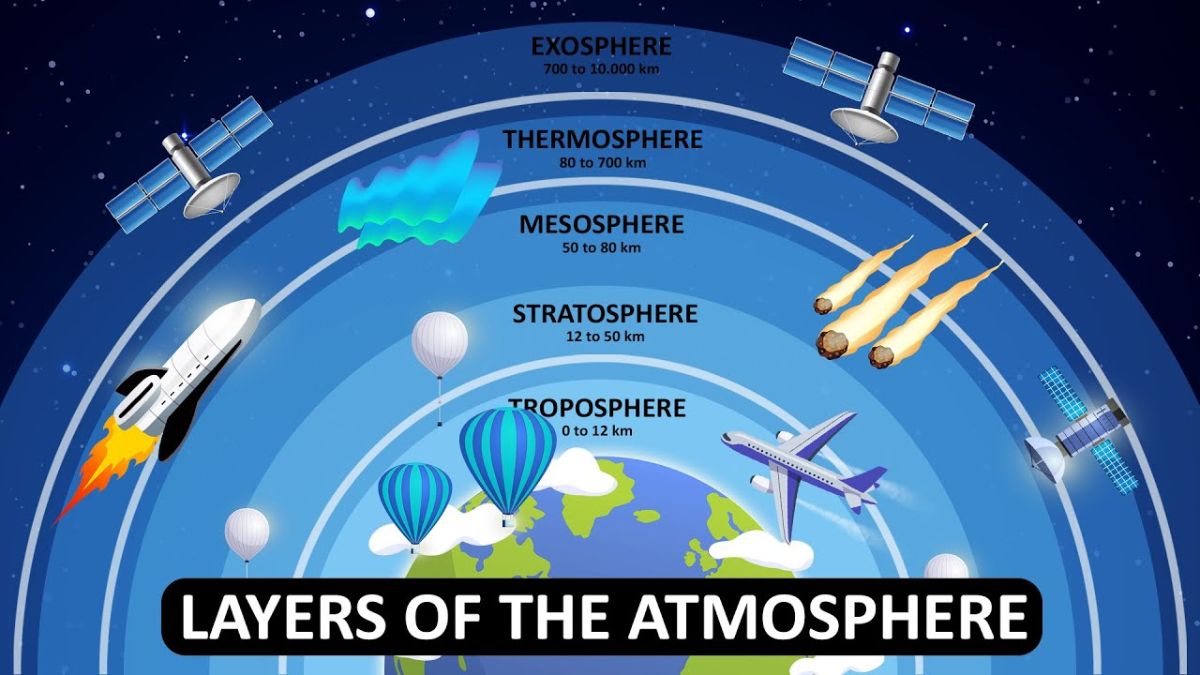
The Earth's atmosphere is divided into five layers. Starting from the earth's surface, the layers are Troposphere, Stratosphere, Mesosphere, Thermosphere, and Exosphere.
Troposphere
Troposphere is the lowest layer of the atmosphere. From the surface of earth, it extends upto 12 km.
Nearly, all weather phenomena such as rainfall and hailstorm take place in the troposphere.
The height of the troposphere is maximum above the equator and lowest above the polar regions.
The temperature in this layer decreases with height. As you climb higher, the air pressure drops in this layer.
Most clouds appear in this layer because 99 per cent of the water vapour in the atmosphere is found in the troposphere.
Stratosphere
Stratosphere is above the troposphere. It extends upto a height of 50 km.
This layer is ideal for flying aeroplanes as it is free from clouds and weather activities.
Stratosphere contains much of the ozone in the atmosphere. Ozone absorbs UV rays and heats up the atmosphere
Mesosphere
Mesosphere is the third layer of the atmosphere. It lies above the stratosphere, extending upto the height of 80 km.
Meteriotes burn up in this layer. Only rocket-powered aircrafts and sounding rockets reach the mesosphere.
The temperature in this layer gets colder with altitude. The top of this layer is the coldest place found within the Earth system, with an average temperature of about -85 to -90 degrees Celsius.
The scarce water vapour present at the top of the mesosphere form noctilucent clouds.
Thermosphere
Thermosphere is the layer above mesosphere, extending upto 700 km above Earth's surface.
Thermosphere absorbs high energy X-rays and UV radiation from the Sun.
The temperature in this layer increases with altitude due to the low density of molecules found and the air is also very thin, which is why it would freezing cold in this layer.
The lowest part of Thermosphere contains the ionosphere.
Thermosphere aids radio transmission. Different satellites also orbit the Earth within this layer.
Auroras (the Northern Lights and Southern Lights) occur in the thermosphere.
Exosphere
Exosphere is the upper most layer of the atmosphere, extending upto 10,000 km above Earth's surface.
There is no weather activity in this layer. The air is very thin in the exosphere. Light gases like helium and hydrogen float into the space from here.
Most satellites in this layer orbit the Earth.

Roopashree Sharma is an experienced broadcast journalist with over 7 years of experience, specialising in beats including geopolitics, defence, and general awareness. She has worked in the roles of correspondent and producer for leading media houses, including Zee, WION, and Economic Times. Currently serving as Deputy Manager – Editorial at Jagran New Media, she produces explainer articles and videos for the General Knowledge (GK) section of the Jagran Josh (English) portal. For inquiries, contact her at roopashree.sharma@jagrannewmedia.com.


