PSLV vs GSLV vs LVM3 vs SSLV: Payload Capacity and Orbit Comparison
This article compares ISRO's four operational launch vehicles: SSLV, PSLV, GSLV and LVM3, detailing their payload capacities, target orbits and key advantages. It highlights their specific roles in India's diverse space missions from small satellite launches to heavy-lift and human spaceflight.
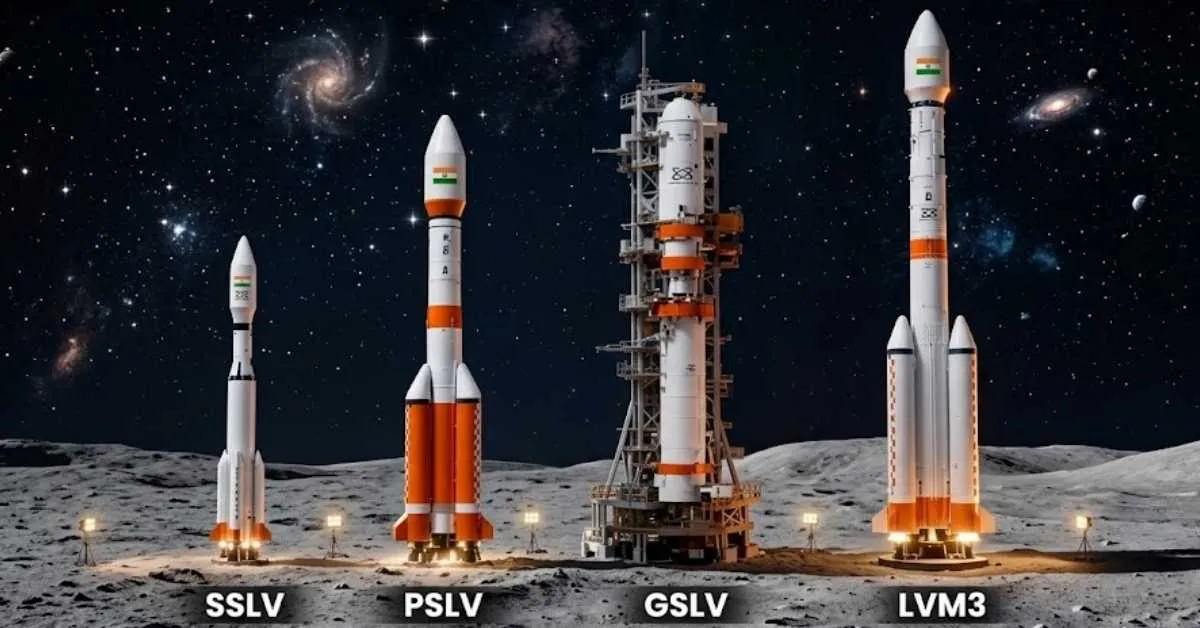
India's space program, spearheaded by ISRO (Indian Space Research Organization), has placed India at the forefront of the world in the cheap and efficient satellite-launching business. ISRO's fleet of different rockets has enabled the launch of small satellites into low orbits as well as sending space probes toward the moon or farther depths of space.
ISRO's Launch Vehicles
ISRO has four functional and operational launch vehicles. Each vehicle caters to a certain mission profile and orbit:
-
SSLV (Small Satellite Launch Vehicle): intended for low-cost launch and quick turn-around of small satellites.
-
PSLV (Polar Satellite Launch Vehicle): ISRO's reliable and trusted space vehicle, mostly used for Earth observation and for launching satellites into polar orbits.
-
GSLV (Geosynchronous Satellite Launch Vehicle): designed for the launch of communication satellites weighing in the medium category and utilizing indigenous cryogenic upper stage.
-
LVM3 (Launch Vehicle Mark-3 / GSLV Mk III): India's heaviest operational rocket, popularly known as "Bahubali," used for carrying heavier payloads, conducting deep space missions and human space travel projects.
PSLV vs GSLV vs LVM3 vs SSLV
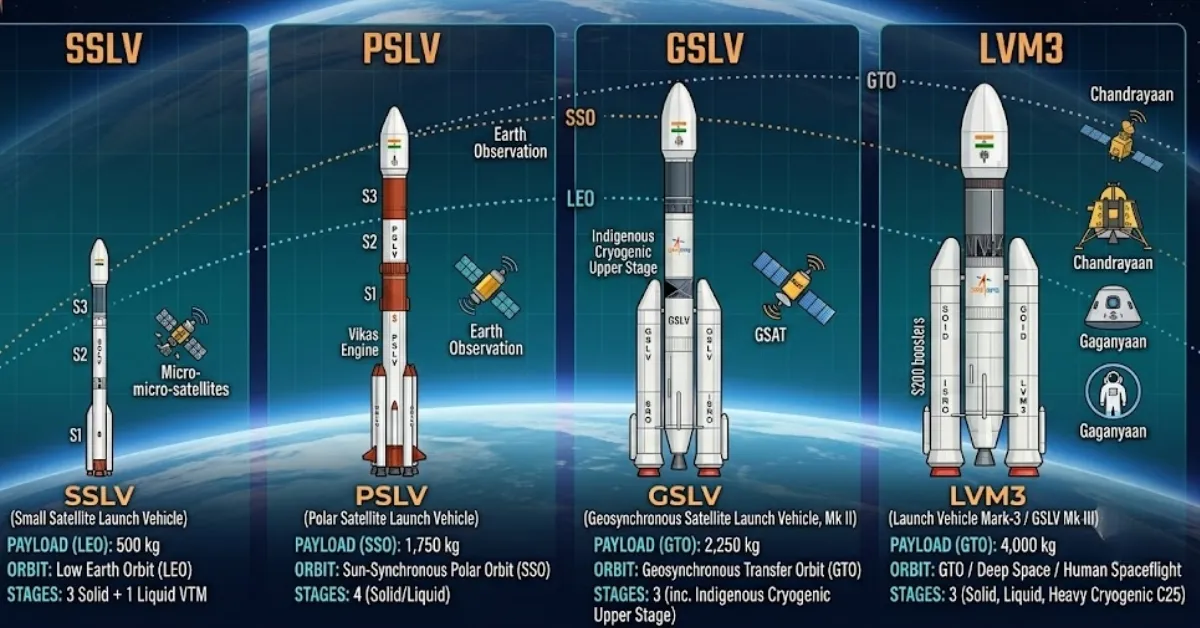
The following table summarizes the specifications and capabilities of ISRO’s active launch fleet:
| Feature | SSLV | PSLV (XL Variant) | GSLV (Mk II) | LVM3 (GSLV Mk III) |
| Number of Stages | 3 Solid + 1 VTM (Liquid) | 4 (Solid/Liquid alternative) | 3 (Solid, Liquid, Cryogenic) | 3 (Solid, Liquid, Cryogenic) |
| LEO Payload Capacity | Up to 500 kg | Up to 3,800 kg | Up to 6,000 kg | Up to 8,000 kg |
| SSO / GTO Payload Capacity | 300 kg to SSO | 1,750 kg to SSO | 2,250 kg to GTO | 4,000 kg to GTO |
| Primary Target Orbits | Low Earth Orbit (LEO) / SSO | Sun-Synchronous Orbit (SSO) | Geosynchronous Transfer Orbit (GTO) | Heavy GTO / LEO / Interplanetary |
| Key Advantage | Turnaround in days; low cost | Extremely high reliability rate | Indigenous Cryogenic Stage (CE-7.5) | Heavy-lift capacity; Human-rated (Gaganyaan) |
1. SSLV (Small Satellite Launch Vehicle)
-
Target Orbit: LEO (Low Earth Orbit) below 500 km.
-
Payload Capacity: 500 kg when placed at LEO and 300 kg when placed in SSO.
-
Stages: It consists of 3 solid-propellant stages along with the Velocity Trimming Module (VTM) liquid propulsion technology used for accurate satellite placing.
-
Significance: Made for commercial on-demand launches minimizing launching infrastructure and construction time of days against weeks for bigger rockets.
2. PSLV (Polar Satellite Launch Vehicle)
-
Target Orbit: It is used for Sun-Synchronous polar orbits i.e 600–900 km and various earth observation orbits.
-
Payload Capacity: PSLV can deliver 1,750 kg to SSO and 3,800 kg when LEO depending on configuration for example, PSLV-XL.
-
Stages: It consists of 4 different stages alternating the use of solid propellant engines and liquid propulsion stages (Vikas engine used).
-
Significance: PSLV is known well as ISRO’s workhorse, having put some of the renowned payloads such as Chandrayaan-1, Mangalyaan and record-breaking launch of 104 satellites at once.
3. GSLV (Geosynchronous Satellite Launch Vehicle Mk II)
-
Orbit goal: Geosynchronous transfer orbit (GTO) at a height of ~36,000 km.
-
Payload capability: 2,250 kg in the GTO; 6,000 kg for low Earth orbit.
-
Stages: consists of three stages – a solid core engine and four liquid boosters, a liquid second stage, and a home-made cryogenic upper stage (CUS) with CE-7.5 engine.
-
Importance: this rocket made India independent in its access to high-altitude markets for INSAT and GSAT heavy satellites.
4. LVM3 (Launch Vehicle Mark-3)
-
Orbit goal: heavy GTO, low Earth orbit and deep space trajectories.
-
Payload capability: 4,000 kg to the GTO; 8,000 kg to low Earth orbit.
-
Stages: consists of three stages – two solid S200 strap-on boosters and an L110 twin-liquid core engine, and a cryogenic engine with C25 engine (CE-20 engine).
Key Takeaways for Competitive Exams
-
The SSLV, which is a member of the Indian Space Research Organization (ISRO) operational fleet, is also called the smallest rocket in the fleet while LVM3 is known to be the heaviest rocket.
-
The GSLV rockets incorporate the well-known CE-7.5 engine, in contrast to the LVM3 which is equipped with the more advanced CE-20 engine.
-
The recent human flight program is organized on LVM3.
-
The PSLV rocket is designed on a four-stage model thus containing components from both solid and liquid propulsion systems.
-
The PSLV rocket uses the indigenous Vikas engines on the propulsive segment.
-
PSLV rocket does not have cryogenic propulsion.
-
Historic Events of PSLV: PSLV has brought numerous important events to India such as Chandrayaan-1, Mangalyaan (Mars Orbiter Mission), Aditya-L1 with several records achieved including the launch of 104 satellites at once.
-
POEM: POEM stands for PSLV Orbital Experimental Module that uses the fourth stage of PSLV rocket for carrying out experiments in space.
-
GSLV Mk II: The rocket has a 3-stage construction plan by means of utilizing solid core and booster segments.GSLV Cryogenic engine utilizes the indigenous CE-7.5 Cryogenic Engine using Liquid Hydrogen and Liquid Oxygen).
-
SSLV is designed for commercial on-demand launches (up to a load of 500 kg to LEO) with a 3-solid stage + liquid VTM design and timely turnaround of only 72 hours.
-
Gaganyaan Link: A specially designed human-rated version of LVM3 (HRLV) was chosen to launch India’s crewed spaceflight program.
-
LVM3 Capabilities & Missions is powered by high-thrust CE-20 Cryogenic Engine that launched Chandrayaan-2 and Chandrayaan-3 (moon south pole landing).
-
LVM3 or Bahubali / Fat Boy ISRO’s most powerful operational heavy-lift rocket with the capacity to carry 4,000 kg payload to GTO.
-
GSLV Target Orbit is developed mostly to put heavy GSAT and INSAT communication satellite into geosynchronous transfer orbit (GTO).

Manisha Waldia is a distinguished content strategist with 5 years of experience crafting premium educational content for UPSC and State PCS, with a focus on deep conceptual analysis across Polity, Geography, History, and Environment. She currently brings this expertise to Jagran Josh, where she covers major national and international events, current affairs, and static general knowledge. Over her career, Manisha's specialized insights have led her to curate high-impact materials and serve as a UPSC Mains answer-evaluator for India’s top institutes—including Drishti IAS, Shubhra Ranjan IAS, Study IQ, GS Score, and PWonlyIAS. She has also worked alongside leading NGOs like Oxfam India and Avani Kumaon.
Contact: manisha.waldia@jagrannewmedia.com



![[Out] UGC NET June 2026 Result Live: यूजीसी नेट रिजल्ट ugcnet.nta.nic.in जारी, डायरेक्ट लिंक से करें चेक](https://img.jagranjosh.com/images/2026/August/2782026/UGC-NET-Result-2026-Marksheet-link-pdf.jpg)