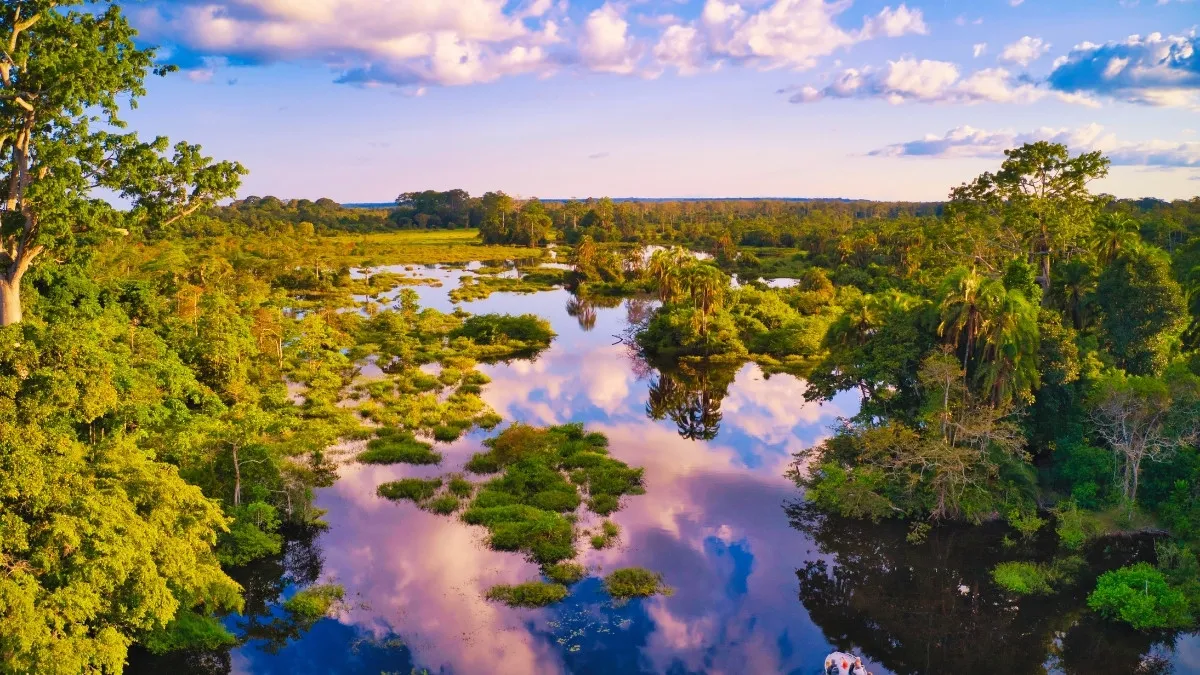
Countries with No Deserts: The list of countries without deserts includes countries where climate, rainfall, and geography prevent the dry, barren landscape typically associated with deserts. These countries often have forests, mountains, rivers and consistent rainfall throughout the year, keeping their lands green and fertile. This topic is important today because understanding global climate patterns helps students and travelers see how geography shapes everyday life, agriculture, and ecosystems.
According to global climate data used by environmental research organizations, deserts cover about 30% of Earth's land surface, meaning that many countries avoid desert conditions entirely due to location, ocean currents, and altitude. Check the list of countries with no deserts below in the article. Read how these Countries with No Deserts matter, related climate facts and stats, along with brief details about the top 3 Countries with No Deserts.
List of Countries With No Deserts
The list of countries without deserts includes many countries in Europe, parts of Asia, Africa and the Americas where rainfall, humidity and forests prevent dry desert climates from forming. These countries often have temperate, tropical, or polar climates. Below is a table showing some of the largest and most notable countries without deserts.
| Country | Continent | Climate type |
| Democratic Republic of Congo | Africa | Tropical rainforest and savanna |
| France | Europe | Temperate with varied regional climates |
| Indonesia | Asia | Tropical rainforest and monsoon |
| Germany | Europe | Temperate, continental, and oceanic climates |
| Ukraine | Europe | Temperate continental |
| Thailand | Asia | Tropical monsoon |
| Sweden | Europe | Temperate and subarctic |
| Japan | Asia | Humid subtropical and continental |
| Vietnam | Asia | Tropical monsoon |
| Papua New Guinea | Oceania | Tropical rainforest |
Check Out | Countries With No Mountains in the World: List of Top 5!
Top 3 Countries with No Deserts
The top 3 countries with no desert are the Democratic Republic of Congo, France, and Indonesia, which are all with high rainfalls, forests, and diverse non-arid landscapes.
1. Democratic Republic of Congo
The Democratic Republic of Congo is the largest desert-free country in Africa at 2.3 million square kilometres. The vast rainforests, the Congo River, and tropical climate keep it wet and green throughout the year.
-
It houses the Congo Rainforest, the second largest rainforest in the world after the Amazon.
-
Heavy rainfall throughout the year prevents the formation of any dry desert areas.
-
It is dominated by rivers and wetlands with dense vegetation rather than sand or barren lands.
2. France
By land area, France is the largest country in Europe, but despite the great variety of climates-from Mediterranean coasts to Alpine mountains-it contains no desert areas. Its position in Western Europe guarantees frequent rainfalls and generally moderate temperatures.
-
France has forests, fields, rivers and mountain ranges, but no true deserts.
-
Even the driest areas of southern France are getting enough rainfall to avoid being classified as deserts.
-
Diverse ecosystems in the country support agriculture, tourism, and biodiversity without dry areas.
3. Indonesia
Indonesia is the world's largest island nation and has no deserts whatsoever; much of the country is covered in tropical rainforests and volcanic mountains. This shocks many, as one would think any large country would have at least one desert, but Indonesia's equatorial location keeps it wet and humid year-round.
-
Indonesia receives heavy rainfall from its monsoon and has among the highest rainfall in the world.
-
It is an archipelago comprising over 17,000 islands, none of which is a desert.
-
The typical landscapes are dominated by dense forests, rice fields, and volcanic soils instead of dry sandy areas.
Why Do These Countries Have No Deserts?
The following countries avoid deserts: the Democratic Republic of Congo, France, Germany, Indonesia, and Europe, due to abundant rainfall, dense forests, or a temperate climate. Its equatorial position or high humidity from the influence of the ocean prevents aridity, thus lush vegetation would take its place. Without a prolonged drought, there is no true desert.
Why Do Countries With No Deserts Matter?
Countries with equatorial rainforests or deserts, such as temperate Europe, are important in terms of global biodiversity, sustainable agriculture, and climate balance. Their rich ecosystems amply store carbon, combat deforestation, and assure unproblematic food security devoid of drought risks.
Read About | Driest Countries in the World in 2025: Top 7 Ranked List!
Conclusion
The list of countries without deserts shows how climate, rainfall and geography shape the land we live on. Countries like the Democratic Republic of Congo, France and Indonesia prove that not all large countries have arid regions. For students preparing for exams or anyone curious about world geography, remembering these desert-free countries helps build a clear picture of Earth's climate diversity.



-1767332640085.jpg)

Comments
All Comments (0)
Join the conversation