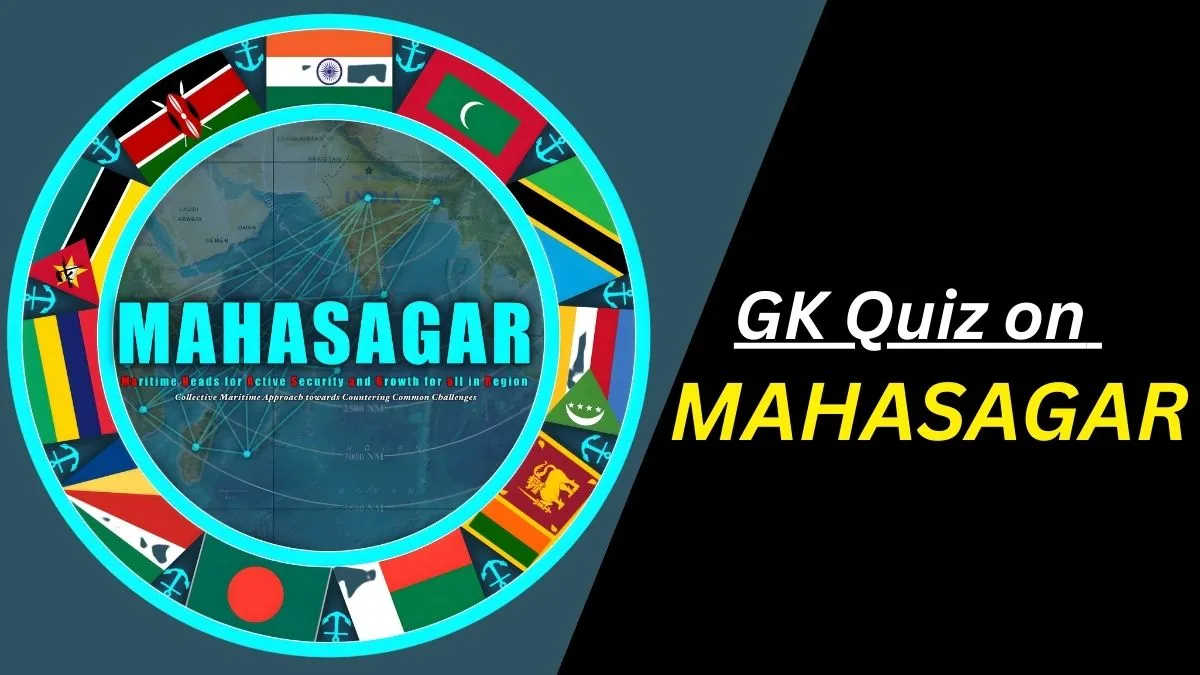
Key Points
- MAHASAGAR expands SAGAR's focus to include economic and geopolitical concerns.
- SAGAR, launched in 2015, focused on maritime security in the Indian Ocean.
- MAHASAGAR aims to strategically contain growing Chinese influence in the region.
The new MAHASAGAR initiative, which was an extensive version of the SAGAR, is aimed at improving maritime security. This new extension shifted from just maritime security to economic and geopolitical concerns.
The term ”MAHASAGAR”, which also means “Great Ocean”, suggests a more ambitious approach toward the maritime objectives for India.
MAHASAGAR, which stands for “Maritime Heads for Active Security And Growth for All in the Region”. This new initiative also holds the importance significance for the Strategic Containment of Chinese Influence.
So, let’s explore the basic understanding of MAHASAGAR with these conceptual MCQs.
GK Question with Answer on MAHASAGAR
1. With reference to India’s maritime strategy, consider the following statements:
-
SAGAR was launched in 2015 to enhance India’s maritime engagement.
-
MAHASAGAR replaces SAGAR entirely.
-
MAHASAGAR expands its focus beyond maritime security to economic and geopolitical concerns.
Which of the statements given above is/are correct?
A. 1 and 2 only
B. 1 and 3 only
C. 2 and 3 only
D. 1, 2 and 3
Answer:B
Explanation: SAGAR was launched in 2015 for maritime security, but on 29 November 2023, the extension version of SAGAR, as MAHASAGAR, was hosted by the Indian Navy. It broadens the scope from maritime security to include economic and geopolitical dimensions.
2. The SAGAR Doctrine is based on which of the following pillars?
-
Security Cooperation
-
Trade and Economic Integration
-
Climate Change Mitigation Treaty Enforcement
-
Connectivity and Infrastructure
Select the correct answer using the code below:
A. 1, 2 and 4 only
B. 1 and 3 only
C. 2 and 3 only
D. 1, 2, 3 and 4
Answer:A
Explanation:
SAGAR has five pillars, which are:
-
Security Cooperation,
-
Trade & Economic Integration,
-
Capacity Building,
-
Sustainable Development
-
Connectivity & Infrastructure.
It does not include the enforcement of climate treaties as a pillar.
3. The term ‘MAHASAGAR’ signifies:
A. Maritime Alliance for Humanitarian Assistance and Security
B. Military Alliance for Strategic and Geopolitical Action
C. Great Ocean, reflecting broader maritime ambition
D. Maritime and Homeland Security Agreement for Regional Governance
Answer:C
Explanation: MAHASAGAR, which also means “Great Ocean,” reflects India’s expansion toward not only global maritime security, but also concern regarding economic and geopolitical issues.
4. Which of the following best explains India’s shift from SAGAR to MAHASAGAR?
A. To withdraw from Indian Ocean engagements
B. To focus exclusively on naval modernisation
C. To counter China’s growing influence in the Indo-Pacific
D. To privatise maritime infrastructure
Answer:C
Explanation: India’s shift from SAGAR to MAHASAGAR aims to respond to China’s Belt and Road Initiative (BRI) and String of Pearls strategy in the Indo-Pacific and Indian Ocean Region.
5. With reference to China’s “String of Pearls” strategy, consider the following statements:
-
It involves developing a network of ports in the Indian Ocean Region.
-
It strengthens China’s maritime presence in strategic locations.
It is part of India’s SAGAR doctrine.
Which of the statements given above is/are correct?
A. 1 and 2 only
B. 2 only
C. 1 and 3 only
D. 1, 2 and 3
Answer:A
Explanation: The String of Pearls refers to China’s network of strategic ports in the IOR. It is not part of India’s SAGAR doctrine.
6. Which of the following countries has been a key beneficiary of India’s SAGAR initiative?
-
Sri Lanka
-
Maldives
-
Seychelles
-
Japan
Select the correct answer:
A. 1, 2 and 3 only
B. 1 and 4 only
C. 2 and 3 only
D. 1, 2, 3 and 4
Answer:A
Explanation: Under SAGAR, India provided naval aid and assistance to Sri Lanka, the Maldives, Seychelles, and Mauritius. Japan is not mentioned in this context.
7. Which of the following is NOT a feature of MAHASAGAR?
A. Strategic containment of Chinese influence
B. Expansion of Blue Economy initiatives
C. Withdrawal from Global South diplomacy
D. Strengthening maritime security cooperation
Answer:C
Explanation: MAHASAGAR augments the position of India in the Global South; it refuses to take away its place.
8. The concept of the Blue Economy under MAHASAGAR refers to:
A. Militarisation of sea lanes
B. Sustainable economic use of marine resources
C. Privatisation of fisheries
D. Deep-sea mining for strategic minerals only
Answer:B
Explanation: Blue Economy focuses on the sustainable exploitation of the ocean resources in terms of economic development and the biosphere.
9. Which of the following benefits does India derive from MAHASAGAR?
-
Enhanced naval power status
-
Greater regional leadership in the Global South
-
Reduced maritime trade security
-
Improved technological and infrastructure development
Select the correct answer:
A. 1, 2 and 4 only
B. 1 and 3 only
C. 2 and 3 only
D. 1, 2, 3 and 4
Answer:A
Explanation: MAHASAGAR improves the naval capabilities, the regional leadership and infrastructure development in India. It enhances the security of maritime trade and does not diminish it.
10. Consider the following statements regarding India as a “Net Security Provider” in the Indian Ocean Region:
-
It involves providing naval assistance and intelligence sharing.
-
It aims to ensure maritime stability for regional partners.
-
It excludes humanitarian assistance and disaster relief.
Which of the statements given above is/are correct?
A. 1 and 2 only
B. 2 only
C. 1 and 3 only
D. 1, 2 and 3
Answer:A
Explanation: India’s role as a net security to provides as a net security provider covers the naval assistance, intelligence assistance, maritime stability and humanitarian assistance. Hence, statement 3 is incorrect.



Comments
All Comments (0)
Join the conversation