Blood Moon August 2026: Partial Lunar Eclipse Timing, Saturn Pairing, and Where to Watch on Thursday
A deep 96.2% partial lunar eclipse will transform the Moon into a rusty-red Blood Moon overnight on August 27 - 28, 2026. Stargazers across North America, South America, Europe, and West Africa can watch the celestial event glowing right next to Saturn.
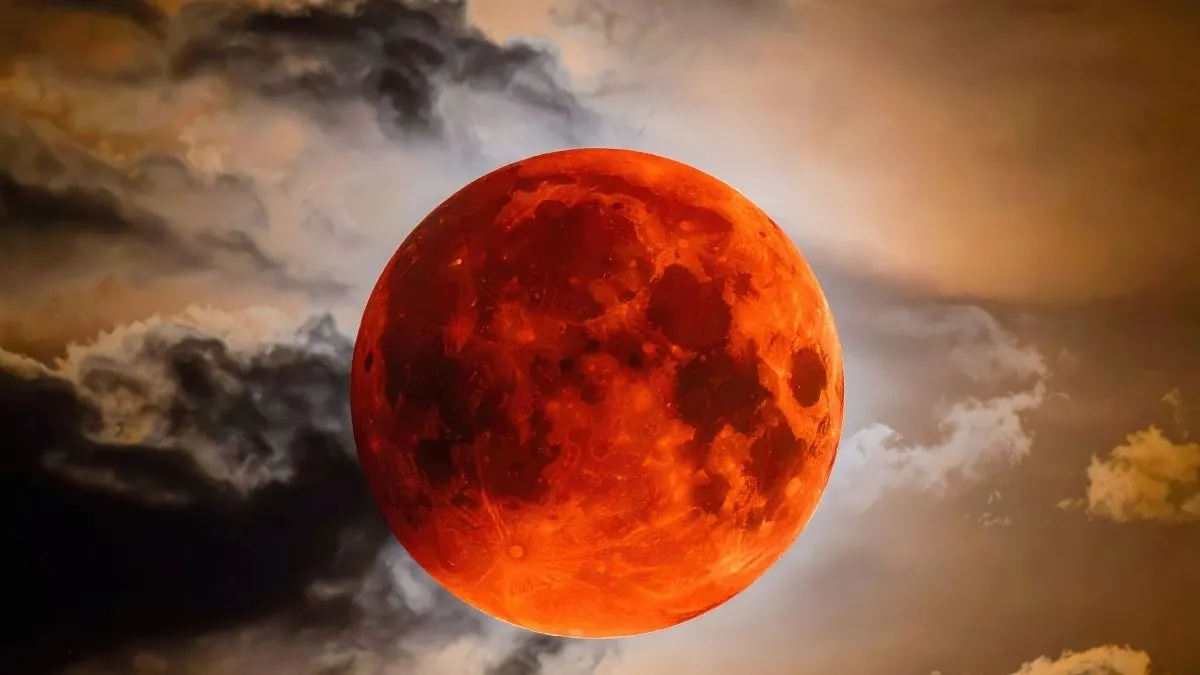
Skywatchers all over the world will witness a great celestial event on the night of August 27 and 28 2026. This will be the last eclipse of the year and the full Sturgeon Moon will turn into the Blood Moon tonight.
The Scientific Visualization Studio at NASA states that at the peak of this eclipse the darkest shadows of Earth will envelop around 96.2% of the moon.
This celestial event is technically classified as a partial lunar eclipse. But it will look nearly identical to a total eclipse.
When is the Blood Moon Lunar Eclipse in August 2026?
The deep partial eclipse lasts for about five hours from start to finish. People in North and South America experience the phenomenon towards the end of Thursday night. And the UK and Western Europe population will get to witness the peak of the Blood Moon just before dawn on Friday.
| Partial Eclipse Phase | UTC Timing | Eastern Daylight Time (EDT) | Visibility Region |
| Penumbral Begins | Aug 28, 01:23 UTC | Aug 27, 9:23 PM EDT | Subtle fading across the Moon |
| Partial Eclipse Begins | Aug 28, 02:33 UTC | Aug 27, 10:33 PM EDT | Dark bite visible on lunar edge |
| Maximum Eclipse (Peak) | Aug 28, 04:12 UTC | Aug 28, 12:12 AM EDT | 96% coverage; coppery-red tint |
| Partial Phase Ends | Aug 28, 05:51 UTC | Aug 28, 1:51 AM EDT | Umbra completely clears Moon |
Where will Blood Moon Lunar Eclipse be Visible Tonight?
Visibility depends on location and local moonrise or moonset times during peak coverage.
Full Blood Moon Eclipse Visibility
- United States: US: States in the East and Midwest including New York, Florida, Texas, Illinois, and Pennsylvania will get to enjoy full visibility of lunar eclipse from start to finish.
- Latin America: Brazil, Argentina, Chile, Colombia, and Mexico have optimum top down visibility during the night.
- Canada: Eastern provinces including Ontario, Quebec, and Nova Scotia experience the complete phase of shadow formation.
A partial lunar eclipse will pass over the Americas—and parts of Europe and Africa—tomorrow night! It will reach its peak around 12:12am ET (0412 UTC) on Thursday, Aug. 28.
— NASA (@NASA) August 26, 2026
More info: https://t.co/deDCMRSq74 pic.twitter.com/2EFqh7jZFn
Partial Blood Moon Phase Visible (Moonset Limits)
- Western US and Canada: California, Washington, Oregon, and British Columbia see maximum eclipse. The initial dimming starts just around moonrise.
- United Kingdom and Western Europe: England, Scotland, Ireland, Portugal, Spain, and France catch peak shadow low on the western horizon before dawn.
- West Africa: The celestial event viewers in Morocco, Senegal, Ghana, and Nigeria can see the red moon close to moonset.
How to Watch and Where the Lunar Eclipse Misses Out
A partial lunar eclipse can be viewed without the need for any eclipse glasses, solar filters, or special telescopic lenses.
- No Visibility Zones: India, China, Japan, Australia, and New Zealand miss out entirely as the Moon remains below the horizon during event hours.
- Partial Viewing Strategy: Observers in Western Europe and the UK need an unobstructed view facing west as the Moon will sit low near the horizon.
A Rare Double Sky Show to Close Out August 2026
This partial lunar eclipse will happen two weeks after the August 12 total solar eclipse. The visibility of this eclipse concludes the orbit pair. Why we say so? Scientists at NASA notes that another 96% deep partial lunar eclipse will not occur for several years.
Skywatchers in active viewing regions should step outside late Thursday or early Friday to enjoy the red Moon standing next to golden Saturn.

Harshita Singh is an education and general knowledge journalist with over 5 years of experience in educational writing. Specializing in US affairs and GK, Harshita has a track record of breaking down intricate geopolitical and historical subjects into clear, digestible insights for learners. Her strong background in text analysis, coupled with a Bachelor of Arts (Hons) in English from the University of Delhi, helps her produce authoritative, thoroughly researched content that empowers readers to engage confidently with global current affairs. For inquiries or academic insights, you can reach out to her directly at harshita.singh@jagrannewmedia.com.