Key Points
- Ancient gurukuls existed in India long before British schools.
- British education began in the 1800s with English and science.
- Modern India blends ancient learning with British-style schools.
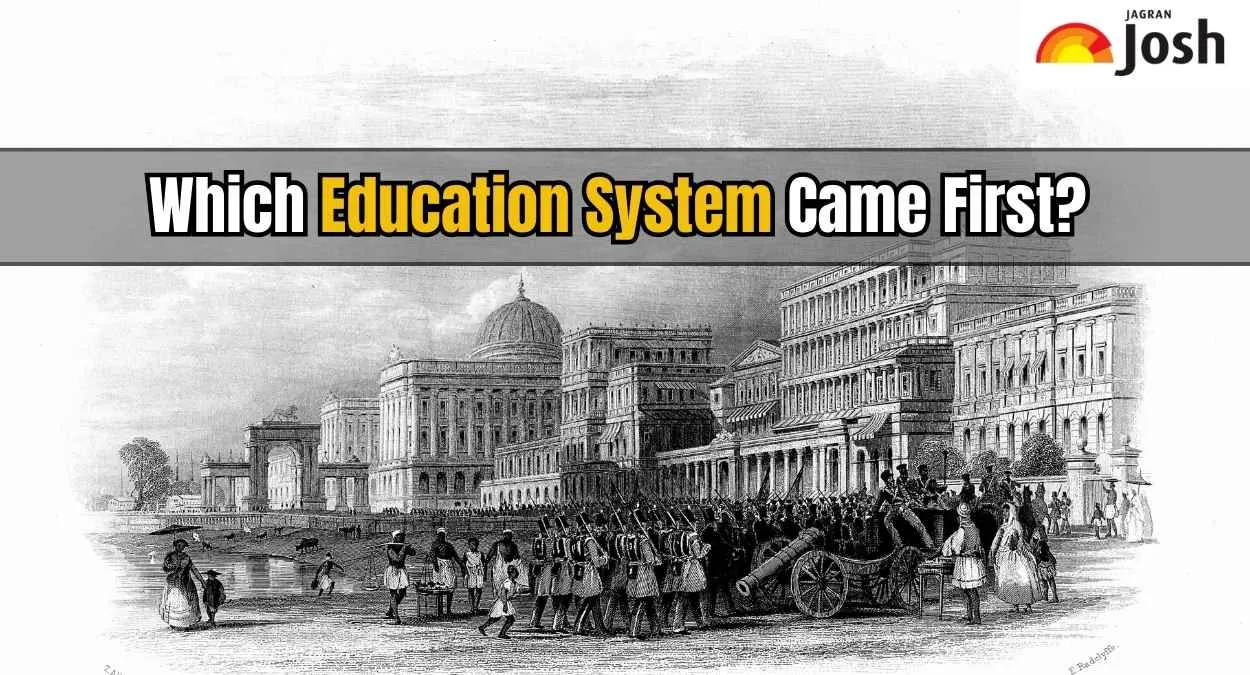
Which Education System Came First: The Indian education system began long before the British arrived in India. From ancient times, India had well-organised centres of learning such as Takshashila and Nalanda, where students learned subjects like mathematics, grammar, medicine, and philosophy.
These schools followed the gurukul and mahavihara traditions, where teachers and students lived and studied together. The British introduced a Western-style formal school system much later, in the 18th–19th centuries, and made English an important language of instruction.
In short, the Indian education tradition came first, the British system was introduced later, and changed how formal schooling was organised across the country.
History of Indian Education System
Modern education in India began during British rule when the British introduced new schools and colleges. Before their arrival, India already had its own education systems such as gurukuls and madrasas, where children learned from traditional teachers.
In the early years, the East India Company did not pay much attention to educating Indians and ignored this area for nearly sixty years.
Later, three main groups took part in developing modern education in India: the British government, Christian missionaries, and Indian reformers. The British government wanted to educate a small number of Indians so they could help in administrative and government work.
During this time, important institutions like the Calcutta Madrasa (1781) and the Sanskrit College at Benares (1791) were established to teach religious and legal subjects.
Christian missionaries also opened many schools to spread Western education. The Charter Act of 1813 marked the first time the British government officially agreed to support education in India by providing funds.
There was also a debate on whether students should be taught in Indian languages or English, and whether traditional education or Western education was better for the country.
How the British Education System Came to India: Macaulay and the English Education Act
Students can learn how the British education system started in India and why English became an important subject in schools. The points below explain the role of Macaulay and the changes made in the education system:
-
In the 1800s, the British ruled India and wanted Indians to learn English and modern subjects.
-
An important event during this time was Macaulay’s Minute (1835).
-
Lord Thomas Babington Macaulay said that education in India should be given in the English language.
-
He wanted students to learn Western subjects like science, law, and new ideas from English books.
-
This led to the English Education Act, which helped in opening many English schools and colleges.
-
The main aim was to prepare people who could work in government offices and courts.
-
This was a big change because earlier education was given in local languages by traditional teachers.
-
New schools started teaching modern science, arithmetic, and English reading and writing.
-
At first, this system was developed in cities and towns.
-
Later, it slowly spread to other parts of the country.
Wood’s Despatch (1854): Spreading Schooling and Formal Education
A few years after Macaulay’s ideas, Wood’s Despatch (1854) became another important step in the history of English education in India. It is often called the “Magna Carta of English Education in India” because it gave clear instructions for improving the school system.
Wood’s Despatch suggested opening more schools and colleges and training teachers properly. It also advised that local languages should be used for young children, while English should be taught at higher levels of education. This helped students learn better at different stages.
The Despatch also supported girls’ education and aimed to make schooling more organized and systematic. As a result, many government schools, teacher training centres, and colleges were established across India. It helped create a balance between regional languages and English in the education system.
Difference Between Ancient Indian Education System and British-based Education System
Students can check the comparison between the ancient Indian education system and the British-based education system introduced later.
| Basis of Comparison | Ancient Indian Education System | British-based Education System |
| Purpose | Focused on teaching life skills, moral values, religion, and a wide range of subjects for the community. | Aimed at preparing clerks and officials to assist in administration and promote Western knowledge. |
| Language of Teaching | Used local languages such as Sanskrit, Prakrit, and regional languages. | Mainly used English, especially at higher levels of education. |
| Teaching Style | Gurukuls were small and personal, with students living near their teachers. | Schools were formal, with fixed timetables, classrooms, and large numbers of students. |
| Subjects Taught | Included arts, mathematics, medicine, and ethics. | Introduced modern science, English literature, law, and administrative subjects. |
| Access to Education | Education was limited to those who could travel or had support, and not all could attend major centres. | Sought to expand schooling, though many social and economic barriers continued to exist. |
The Indian education system existed long before the British introduced formal English schooling in India. Today, modern education in India combines ancient traditions with the British-based system for balanced learning.
Also Check:



Comments
All Comments (0)
Join the conversation