Key Points
- Physics exam on Feb 20, 2026; focus on revision, formulas, and presentation.
- 80% of questions are repetitive; numericals and derivations have fixed patterns.
- Revise NCERT, practice diagrams, and solve previous year's papers.
As the CBSE Class 12 Board Examination 2026 enters its final phase, Physics remains one of the most scoring yet conceptually demanding subjects. The Physics exam will take place on 20th Feb, 2026. Therefore in the last 10 days before the exam, students must shift their focus from learning new topics to structured revision, formula consolidation, numerical accuracy, and answer presentation as per CBSE guidelines. According to the CBSE curriculum framework and previous years’ question trends, Physics questions are largely NCERT-based and application-oriented, making a planned revision strategy essential. This CBSE Class 12 Physics last 10 days study plan for board exam 2026 is designed to help students revise the complete syllabus efficiently.
Why Are the Last 10 Days Crucial for CBSE Class 12 Physics?
The final 10 days play a decisive role in score improvement because:
-
Over 80 percent of Physics board questions are repetitive in concept
-
Numericals and derivations carry fixed scoring patterns
-
Formula retention and diagram practice directly affect marks
-
CBSE emphasises conceptual clarity over rote learning
CBSE Class 12 Physics Exam Pattern 2026
Conducting Body: Central Board of Secondary Education (CBSE)
-
Level: Senior Secondary (10+2)
-
Total Marks: 100
-
Theory: 70 marks
-
Practical: 30 marks
-
Question Types:
-
Multiple Choice Questions (MCQs)
-
Short Answer Questions
-
Long Answer and Case-Based Questions
The CBSE Physics paper tests analytical thinking, numerical problem-solving, and real-life application of concepts.
CBSE Class 12 Physics Unit-Wise Weightage
Understanding syllabus weightage is essential not only for boards but also for general awareness about India’s school education system.
| Unit | Topics | Marks |
| Unit-1: Electrostatics | Chapter 1: Electric Charges and Fields | 16 |
| Chapter 2: Electrostatic Potential and Capacitance | ||
| Unit-2: Current Electricity | Chapter 3: Current Electricity | |
| Unit-3: Magnetic Effects of Current and Magnetism | Chapter 4: Moving Charges and Magnetism | 17 |
| Chapter 5: Magnetism and Matter | ||
| Unit-4: Electromagnetic Induction and Alternating Currents | Chapter 6: Electromagnetic Induction | |
| Chapter 7: Alternating Current | ||
| Unit-5: Electromagnetic Waves | Chapter–8: Electromagnetic Waves | 18
|
| Unit-6: Optics | Chapter–9: Ray Optics and Optical Instruments | |
| Chapter–10: Wave Optics | ||
| Unit-7: Dual Nature of Radiation and Matter | Chapter–11: Dual Nature of Radiation and Matter | 12
|
| Unit-8: Atoms and Nuclei | Chapter–12: Atoms | |
| Chapter–13: Nuclei | ||
| Unit-9: Electronic Devices | Chapter 7 –14: Semiconductor Electronics: Materials, Devices and Simple Circuits | 7 |
Daily Time Division for Physics
| Activity | Time Allocation |
| Formula Revision | 1 hour |
| Concept Revision | 2 hours |
| Numerical Practice | 2 hours |
| PYQs / Sample Questions | 1.5 hours |
| Diagram & Derivation Practice | 1 hour |
CBSE Class 12 Physics Last 10 Days Study Plan 2026 (Day-Wise)
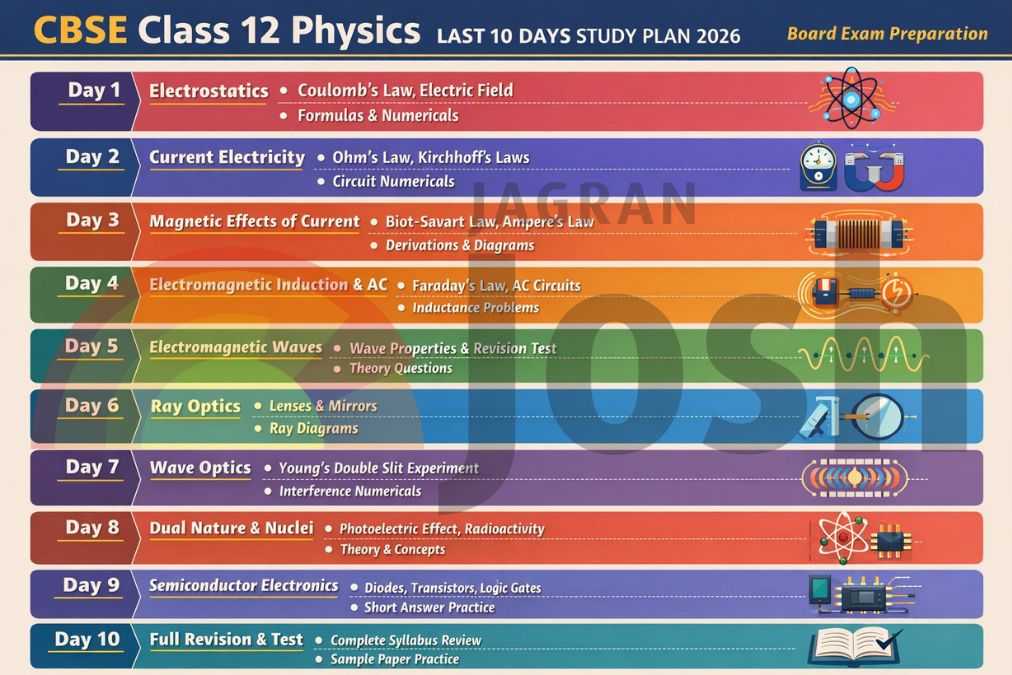
Day 1: Electrostatics
-
Electric charge and Coulomb’s Law
-
Electric field, potential, and capacitance
-
Key derivations and numerical practice
-
Revise NCERT definitions and examples
Day 2: Current Electricity
-
Ohm’s Law and Kirchhoff’s Laws
-
Wheatstone Bridge and Meter Bridge
-
Numerical problems from NCERT and exemplar
-
Revise important formulas
Day 3: Magnetic Effects of Current
-
Biot–Savart Law and Ampere’s Circuital Law
-
Lorentz force and cyclotron
-
Moving coil galvanometer
-
Practice derivations and diagram-based questions
Day 4: Electromagnetic Induction and Alternating Current
-
Faraday’s Laws and Lenz’s Law
-
Self and mutual inductance
-
AC circuits and power factor
-
Solve previous years’ board questions
Day 5: Electromagnetic Waves and Revision
-
Properties and applications of electromagnetic waves
-
Revision of Units 1–4
-
Attempt a sectional test and analyse errors
Day 6: Ray Optics
-
Reflection and refraction
-
Optical instruments and magnification
-
Diagram-based and numerical questions
-
Revise derivations from NCERT
Day 7: Wave Optics
-
Interference, diffraction, and polarization
-
Young’s Double Slit Experiment
-
Formula-based numericals and theory revision
Day 8: Dual Nature of Radiation and Matter, Atoms and Nuclei
-
Photoelectric effect and Einstein’s equation
-
Bohr’s atomic model
-
Nuclear fission and fusion
-
Revise theory-oriented questions
Day 9: Semiconductor Electronics
-
Semiconductor theory
-
Diodes, transistors, and logic gates
-
Applications in modern electronics
-
Focus on short and very short answer questions
Day 10: Full-Length Practice and Final Revision
-
Attempt one full CBSE sample paper
-
Analyse mistakes and weak areas
-
Revise formulas, derivations, and diagrams
-
Light revision only, avoid stress
Important Formula and Diagram Revision Strategy
-
Maintain a single formula notebook
-
Revise formulas twice daily
-
Practice neat, labelled diagrams
-
Focus on derivation steps and units
CBSE Class 12 Date Sheet 2025-26
The CBSE Class 12th exam dates are out for the 2026 board examination. As per the date sheet, the CBSE Class 12 exams will start on Feb 17, 2026. Check the complete CBSE Class 12 Date Sheet 2026 for more information.
The CBSE Class 12 Physics Board Exam 2026 demands strategic preparation rather than last-minute cramming. A well-planned 10-day revision schedule focusing on NCERT concepts, numerical accuracy, and exam-oriented practice can significantly improve scores. By following this comprehensive CBSE Class 12 Physics last 10 days study plan, students can revise the entire syllabus efficiently while also gaining clarity about the CBSE examination framework, which is equally important from a General Awareness perspective.
Also Check:
CBSE Class 12 Physics Deleted Syllabus 2026
CBSE Class 12 Sample Paper: Physics
CBSE Class 12 Toppers Answer Sheet


-1770296627148.jpg)

Comments
All Comments (0)
Join the conversation