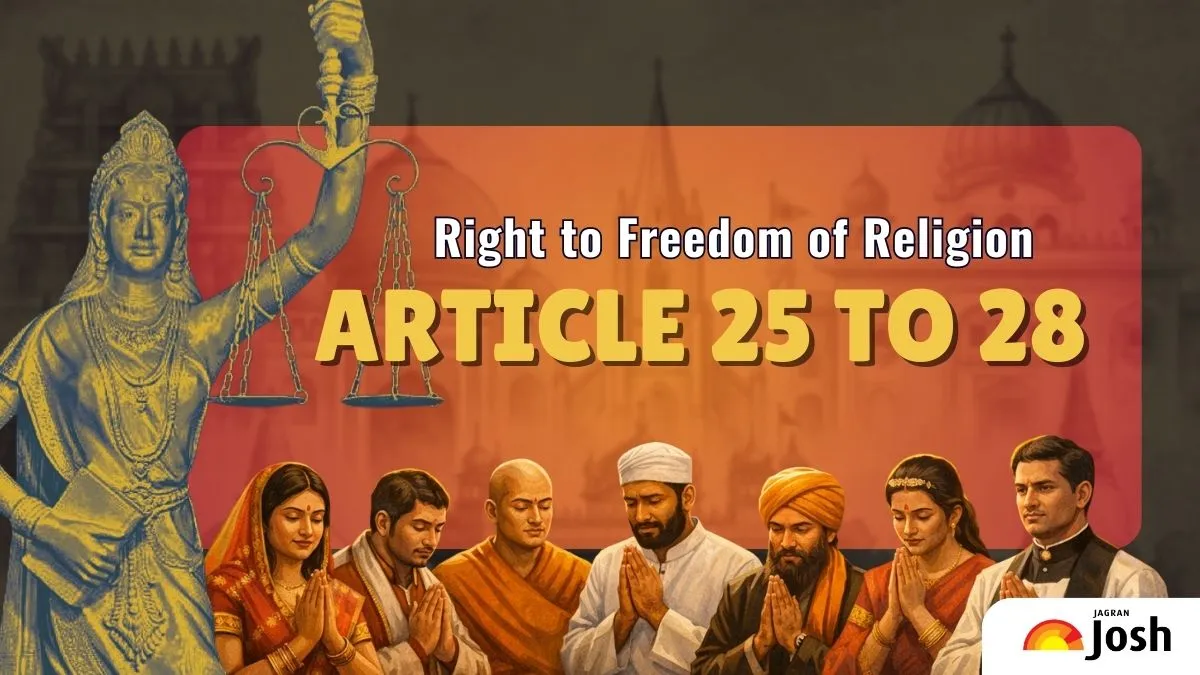
Key Points
- Articles 25-28 of the Indian Constitution guarantee religious freedom as a Fundamental Right.
- Article 25 guarantees individual freedom of conscience and the right to practice religion.
- Article 26 protects the rights of religious denominations to manage their own affairs.
Right to Freedom Religion: India is a land of immense religious diversity, where people of different faiths, beliefs, and practices have lived together for centuries. To preserve this pluralistic character, the Indian Constitution guarantees the Right to Freedom of Religion as a Fundamental Right. Enshrined under Articles 25 to 28, this right ensures religious liberty while maintaining public order, morality, and harmony. In times of debates around secularism, conversions, religious practices, and state intervention, these Articles continue to remain highly relevant.
Right to Freedom of Religion
Right to Freedom of Religion is enshrined in the Indian Constitution in Part III which talks about Fundamental Rights. Here’s the overview of the Right to Freedom of Religion:
| Articles Covered | 25, 26, 27, 28 |
| Part of Constitution | Part III |
| Category | Cultural and Religious Rights |
| Guarantees | Freedom of Conscience and Religious Practice |
| Applies to | Individuals and religious denominations |
| Why it Matters | Protects India’s secular and pluralistic fabric |
What Is the Right to Freedom of Religion?
The Right to Freedom of Religion allows every individual to profess, practice, and propagate any religion of their choice. It also gives religious denominations the right to manage their own affairs. However, this freedom is not absolute and is subject to reasonable restrictions imposed in the interest of public order, morality, health, and other Fundamental Rights.
Together, Articles 25 to 28 strike a balance between individual liberty and social harmony, ensuring that religion does not override constitutional values.
Articles 25 to 28 Explained
Article 25: Freedom of Conscience and Religion
Article 25 under Part III of the Constitution guarantees freedom to profess, practice, and propagate religion of their choice to all the individuals (whether citizens or non-citizens). This freedom is guaranteed unless it affects:
-
Public order,
-
Morality, and
-
Health of the society
It allows the State to regulate secular aspects of religious practices
Example: The State can regulate temple administration but cannot interfere with essential religious beliefs.
Article 26: Freedom to Manage Religious Affairs
Article 26 under the Right to Freedom of Religion focuses on the religious denominations rather than individual practices. The Right for Religious Denominations includes:
-
Right to establish institutions
-
Right to manage religious affairs
-
Right to own and acquire property
Example: A religious trust managing its own place of worship.
Article 27: Freedom from Religious Taxes
The rights under Article 27 protects the individuals from paying any arbitrary taxes in the name of promoting religion. Nobody can ask or compel an individual to pay taxes, proceeds of which are purely to maintain the religious affairs and religious denominations.
Example: Government funds cannot be used exclusively for the promotion of one religion.
Article 28: Freedom in Educational Institutions
-
No religious instruction in state-funded institutions, meaning there will be no compulsion in the institutions entirely or partially funded by the state governments to preach religious instructions.
-
Religious instruction allowed in private or minority institutions
-
Individuals cannot be forced to attend religious worship
Example: A government school cannot mandate religious prayers
Key Features of the Right to Freedom of Religion
-
Ensures freedom of conscience: A person / individual can choose their own path of religion i.e. they can choose which religion they want to follow and practice.
-
Applies Equally to all Religions: The Right to Freedom of Religion is equally applied to all the religions i.e. an individual can choose any religion of their choice.
-
Balances liberty with public order
-
Protects minority religions
-
Strengthens India’s secular character
-
Allows state-led social reforms
Constitutional Background of Religious Freedom
-
Inspired by Indian civilizational values of tolerance
-
Heavily debated in the Constituent Assembly
-
Dr. B.R. Ambedkar emphasized reform over orthodoxy
-
Adopted a positive secularism model (not strict separation)
-
Allowed State intervention for social welfare
Landmark Supreme Court Judgments on Freedom of Religion
| Case Name | Year | Key Judgment |
| Shirur Mutt Case | 1954 | Introduced the “Essential Religious Practices” test |
| Bijoe Emmanuel v. State of Kerala | 1986 | Right to religious belief protected (Jehovah’s Witnesses case) |
| S.R. Bommai v. Union of India | 1994 | Secularism is part of the basic structure |
| Ismail Faruqui Case | 1994 | Religious practice vs essential practice clarified |
| Indian Young Lawyers Association (Sabarimala) | 2018 | Gender equality overrides religious exclusion |
Important Facts About Articles 25-28
-
Religious freedom is subject to restrictions
-
Secular activities linked to religion can be regulated
-
“Essential practices” decided by courts
-
Applies to individuals and groups
-
Not absolute like freedom of conscience
Right to Freedom of Religion: Current Relevance
-
Debates on anti-conversion laws
-
Judicial scrutiny of religious customs
-
State regulation of religious institutions
-
Discussions on secularism and uniform civil code
-
Increasing role of courts in defining essential practices
These developments keep Articles 25-28 constantly in the news.
Difference Between Articles 25, 26, 27, and 28
| Article | Deals With | Scope |
| Article 25 | Individual religious freedom | Broad but restricted |
| Article 26 | Denominational rights | Institutional |
| Article 27 | Religious taxation | Fiscal neutrality |
| Article 28 | Religious instruction | Education-focused |





Comments
All Comments (0)
Join the conversation