Show Key Points
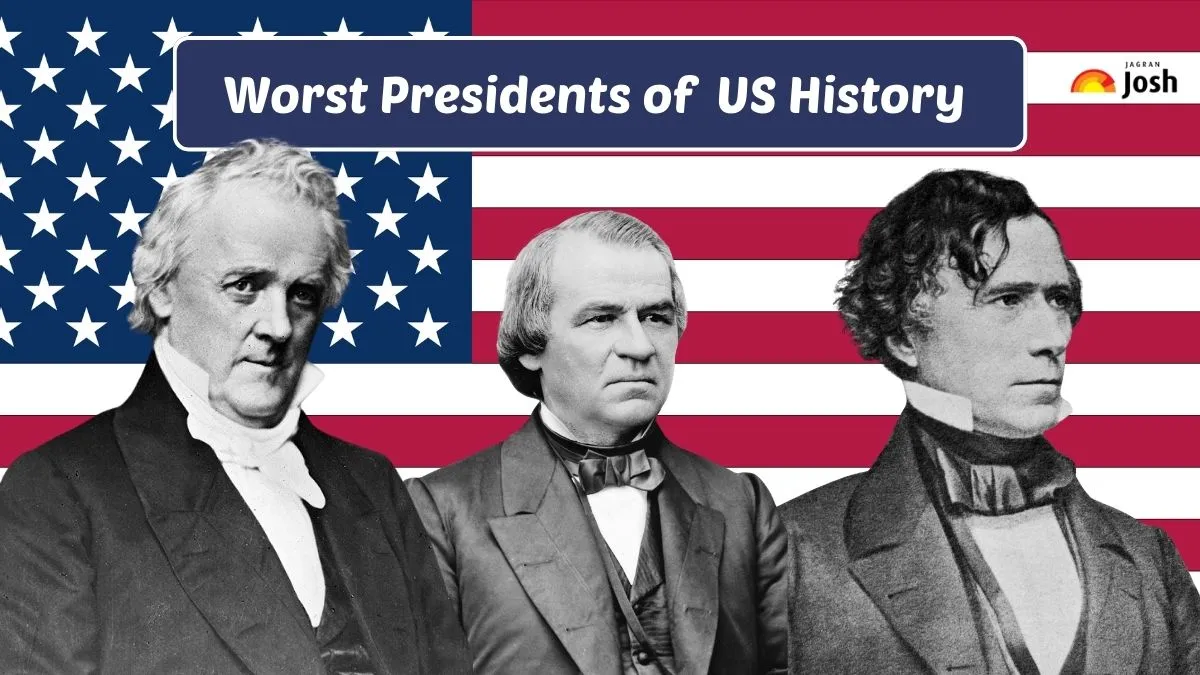
List of worst presidents of the US: To evaluate a leader's legacy, one must transcend contemporary politics and consider the enduring welfare of the republic. According to the 2024 Presidential Greatness Project and the Siena College Research Institute, presidential failures are often defined by an inability to prevent national division or a blatant disregard for institutional norms.
While names like James Buchanan have topped these lists for decades due to their roles in the lead-up to the Civil War, recent surveys have seen new entries and shifts based on updated historical perspectives on civil rights and executive ethics.
List of Worst Presidents of the U.S.
The following rankings of the U.S. presidents provide a sobering look at how the highest office in the land can be mishandled.
| Rank | President Name | Presidential Tenure | Birth & Death Dates |
| 1 | James Buchanan | 1857 – 1861 | April 23, 1791 – June 1, 1868 |
| 2 | Andrew Johnson | 1865 – 1869 | Dec 29, 1808 – July 31, 1875 |
| 3 | Donald Trump | 2017 – 2021 | June 14, 1946 – Present |
| 4 | Franklin Pierce | 1853 – 1857 | Nov 23, 1804 – Oct 8, 1869 |
| 5 | William Henry Harrison | 1841 | Feb 9, 1773 – April 4, 1841 |
| 6 | Warren G. Harding | 1921 – 1923 | Nov 2, 1865 – Aug 2, 1923 |
| 7 | Millard Fillmore | 1850 – 1853 | Jan 7, 1800 – March 8, 1874 |
| 8 | John Tyler | 1841 – 1845 | March 29, 1790 – Jan 18, 1862 |
| 9 | Herbert Hoover | 1929 – 1933 | Aug 10, 1874 – Oct 20, 1964 |
| 10 | Zachary Taylor | 1849 – 1850 | Nov 24, 1784 – July 9, 1850 |
Source: C-SPAN Presidential Historians Survey (2021) & Presidential Greatness Project (2024)
Check Out - Who are the 7 Best American Presidents of All Time? Ranked
1. James Buchanan
Often cited as the worst US president in almost every scholarly poll, Buchanan’s failure lies in his passivity during the secession crisis. The American Battlefield Trust says that his unwillingness to take a strong stand against Southern states leaving the Union made the Civil War unavoidable. He famously said he didn't have the constitutional power to stop secession, which meant he watched the country tear itself apart.
2. Andrew Johnson
Taking office after Lincoln’s assassination, Johnson is criticized by historians for his disastrous handling of Reconstruction. The National Constitution Center notes that his frequent vetoes of civil rights legislation for formerly enslaved people and his lenient treatment of former Confederate leaders led to his impeachment and set back American race relations by nearly a century.
3. Donald Trump
In the 2024 Presidential Greatness Project survey, Donald Trump was ranked as the worst president in history by a plurality of scholars. The ranking was largely influenced by his challenges to the peaceful transfer of power and two impeachments. According to The Guardian, scholars cited his departure from long-standing institutional norms as a primary reason for his bottom-tier placement.
4. Franklin Pierce
A Northern man with Southern principles, Pierce signed the Kansas-Nebraska Act of 1854. This legislation, as documented by Britannica, essentially repealed the Missouri Compromise and led to Bleeding Kansas, a period of violent guerrilla warfare over the expansion of slavery that served as a direct precursor to the Civil War.
5. William Henry Harrison
Harrison often appears on the worst president list not due to malice, but due to a total lack of impact. He holds the record for the shortest presidency in history, dying of pneumonia just 31 days after his inauguration. Historians generally rank him low because he was unable to fulfill any of his campaign promises or exercise executive leadership.
6. Warren G. Harding
Harding’s presidency was defined by the Teapot Dome Scandal, which involved the secret leasing of federal oil reserves. While Harding himself wasn't directly implicated in every crime, the Library of Congress highlights that his administration was one of the most corrupt in history, filled with cronyism and bribery that tarnished the office.
7. Millard Fillmore
Fillmore is largely remembered for signing the Fugitive Slave Act of 1850. This law required that escaped slaves be returned to their masters, even if they were in free states. Historians at the Siena College Research Institute rank him poorly because this act deepened the sectional divide and alienated the abolitionist movement.
8. John Tyler
Known as "His Accidency," Tyler was the first Vice President to ascend to the presidency without being elected. He was so unpopular with his own Whig party that they expelled him while he was still in office. His later decision to join the Confederate House of Representatives further damaged his historical standing as a defender of the Union.
9. Herbert Hoover
While a respected humanitarian before his presidency, Hoover is ranked poorly for his response to the 1929 Stock Market Crash. The National Archives details how his rugged individualism philosophy prevented him from providing direct federal aid, leading to the Hoovervilles that became the face of the Great Depression.
10. Zachary Taylor
Like Harrison, Taylor’s ranking suffers from a shortened term and a lack of legislative achievement. Though he was a war hero, his political inexperience led to a stalled agenda. He died 16 months into his term, leaving behind a country increasingly divided over the issue of slavery with no clear path forward.
Check Out - What is the Presidential Line of Succession in the US? Check Current Order
Historian rankings provide a critical lens through which we view the evolution of American leadership. While modern politics often colors public perception, these scholarly surveys remind us that the ultimate test of a president is their ability to preserve the Union and uphold the democratic values of the Constitution.



Comments
All Comments (0)
Join the conversation