NEET PG 2026 vs 2025 Exam Analysis: Which Paper Was More Difficult?


NEET PG 2026 vs 2025 exam analysis: NEET PG 2026 was rated moderately difficult, with around 50 image-based questions and 70-80 tricky questions, while NEET PG 2025 featured around 70% clinical vignette-based questions and 40%-50% image-based questions.
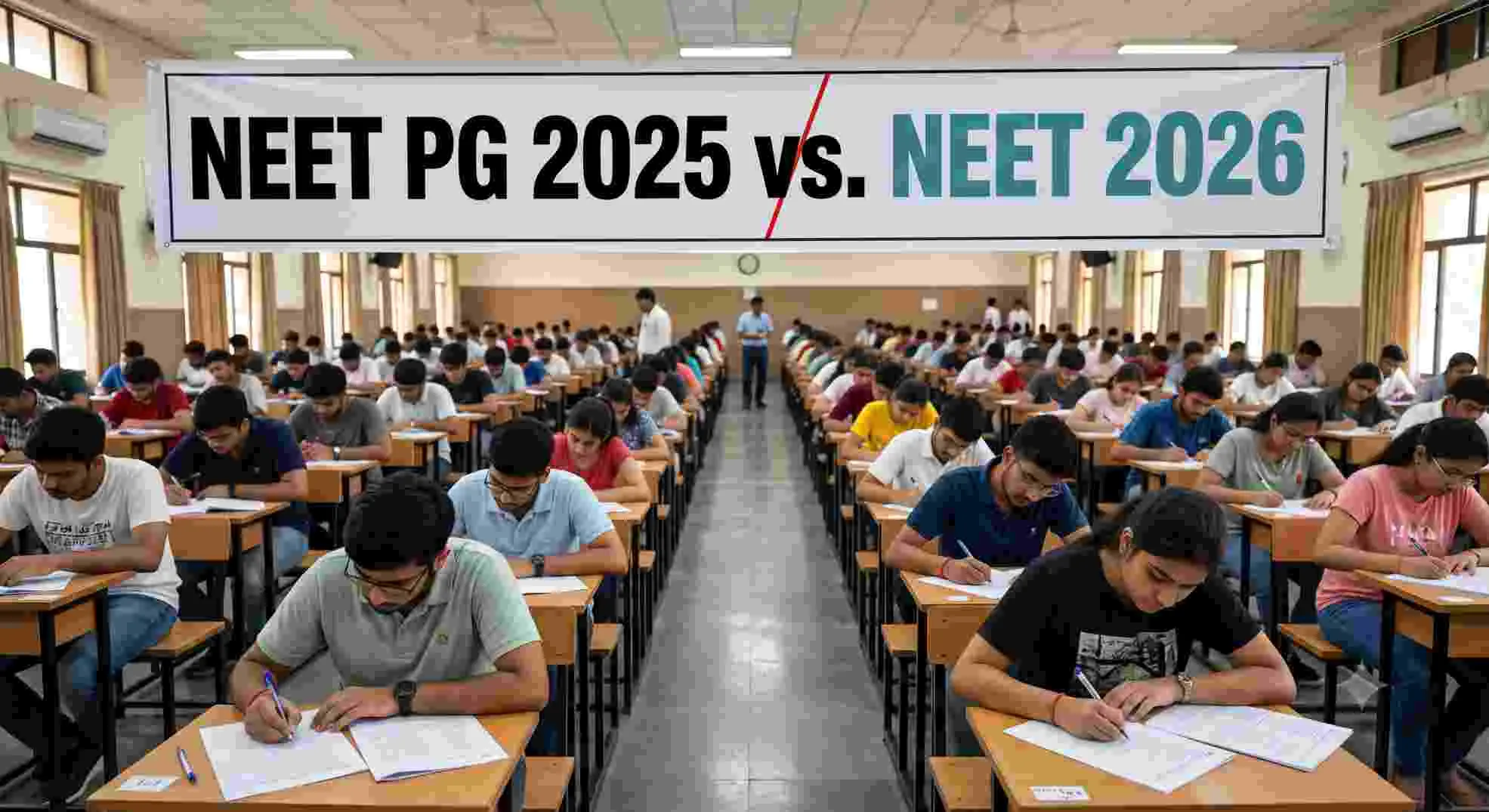
The NEET PG 2026 paper was broadly comparable to NEET PG 2025 in difficulty, but the two examinations differed in the way they tested candidates. While the 2025 paper was heavily centred on clinical vignettes, case-based questions and integrated concepts, the 2026 examination placed greater emphasis on image interpretation, investigations, treatment and clinical decision-making.
Experts described NEET PG 2026 as moderately difficult, with around 20 questions considered easy, another 20 difficult and the majority falling in the moderate category. The paper also contained a sizeable number of tricky questions. NEET PG 2025, meanwhile, was generally assessed as moderate to difficult, with around 70% of questions reportedly based on clinical scenarios or case-based applications.
The proportion of image-based questions was high in both years. In 2025, such questions were estimated to account for around 40% to 50% of the paper, while the 2026 analysis suggests that approximately 50 of the 180 questions were image-based. This indicates that visual interpretation continued to be an important part of NEET PG preparation.
The major difference was therefore not necessarily the overall difficulty, but the nature of the challenge faced by candidates. NEET PG 2025 required extensive clinical reasoning through vignettes, whereas NEET PG 2026 tested candidates through a combination of clinical application, images, investigations, treatment choices and integrated concepts.
NEET PG 2026 Exam Analysis
The NEET PG 2026 paper was rated at around 6.8 out of 10 for difficulty by Dr Priyansh Jain. He estimated that around 70 to 80 questions could be considered tricky or confusing, although none were considered outside the prescribed syllabus.
Jain also said that around 20 questions were easy and around 20 were difficult, with most questions falling between these two categories. He expects a significant number of candidates to have between 120 and 130 correct answers, potentially making negative marking important for determining ranks.
Clinical Application And Integrated Questions
The paper contained relatively few straightforward one-line questions. Instead, candidates had to apply concepts to clinical situations.
Topics including urea cycle disorders, electron transport chain and arachidonic acid were tested, but the questions often required candidates to understand and apply the underlying concepts.
There was also a notable emphasis on investigations and treatment, while diagnosis-based questions were comparatively fewer.
Medicine was extensively integrated with Pharmacology, according to Jain. The paper also included applied Physiology and hypothetical questions, making conceptual understanding more important than simple memorisation.
Image-Based Questions
Around 50 questions were estimated to be image-based in the 2026 examination. The images included questions involving conditions such as adenomyosis and leiomyoma, while some questions required candidates to use figures for staging or interpretation.
Time Management
The sectional timing meant candidates had to manage each section carefully. However, Jain said the reduction in the number of questions from 200 to 180 helped offset the presence of some lengthy questions.
While some questions took considerable time, easier questions allowed candidates to make up for the time spent on longer ones.
NEET PG 2026 Student Reactions
Students largely described the paper as moderate in difficulty and highlighted its practical orientation. Meenu, a NEET PG candidate, said “rote-learning would not have helped”, indicating that candidates had to apply their knowledge rather than rely solely on memorised information. Students also reported that there were no video-based questions.
NEET PG 2025 Exam Analysis
The NEET PG 2025 paper, conducted on August 3, 2025, was similarly dominated by application-based questions rather than straightforward recall.
Around 70% of the questions were estimated to be clinical vignettes or case-based applications, making interpretation of clinical information a major part of the examination.
Direct one-liners reportedly accounted for less than 10% of the paper, while image-based questions made up approximately 40% to 50% of the examination.
Subject-Wise Trends
NEET PG 2025 had considerable representation from Obstetrics and Gynaecology, General Medicine, General Surgery, Pathology, Pharmacology and PSM. Anatomy, Physiology and Biochemistry had comparatively less direct representation, with their concepts frequently integrated into broader clinical questions.
Around 30% of questions or concepts were also reported to have some direct or indirect overlap with previous-year topics and recent FMGE recall material.
NEET PG 2026 vs 2025: Overall Assessment
Both papers demonstrate the continued shift in NEET PG towards clinical application and conceptual understanding. However, the emphasis changed slightly in 2026.
NEET PG 2025 was particularly notable for its clinical-vignette-heavy format, with candidates required to work through case scenarios and integrate concepts across subjects.
NEET PG 2026 retained this application-based approach but placed greater emphasis on images, investigations, treatment and determining the appropriate next step in a clinical setting.
Therefore, NEET PG 2026 cannot be considered substantially tougher than NEET PG 2025 based on the available analysis. The 2026 paper was broadly moderate, although its tricky questions and strong focus on application could make it challenging for candidates who relied primarily on rote learning.
In short, 2025 tested clinical reasoning through extensive case-based questions, while 2026 tested clinical reasoning through a wider mix of images, investigations, treatment decisions and integrated concepts.
Sahil Behl is an education journalist at Jagran with over a year of experience in journalism. Prior to joining Jagran, he worked as a Sub-Editor in NDTV's Education department, where he was responsible for writing and editing education-related content as well as managing the department's social media presence. At Jagran, he covers a wide range of education topics, including board examinations, school updates, admissions, and job notifications, while leveraging his editorial expertise and strong understanding of digital content strategy.
Sahil holds a Bachelor's degree in Business Administration and has also completed an eight-month certification program in Data Science. Passionate about emerging technologies, particularly artificial intelligence, he closely tracks their growing role in journalism and explores how they are transforming shaping the future of the media industry.