Key Points
- Greenland holds over 25% of global demand for critical metals like neodymium and dysprosium.
- Melting ice makes minerals more accessible, attracting countries seeking green technology.
- Greenland has 1.5 million tonnes of REE, the 8th largest reserve, as of Nov 17, 2025.
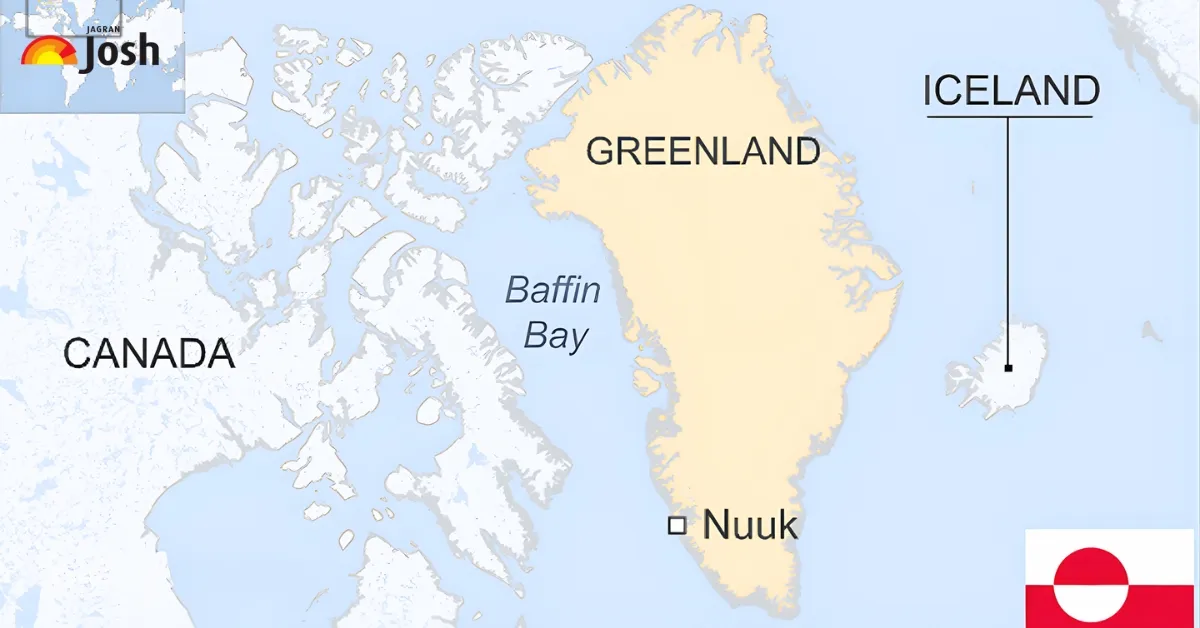
Greenland is the largest island in the world, which is located in a cold, beautiful area between the Arctic and Atlantic Oceans. Geographically, it belongs to North America, but it is closely connected to Europe. To the west is Canada, and to the southeast is Iceland.
Politically, Greenland is an autonomous territory of the Kingdom of Denmark. This means it takes care of its own local matters, while Denmark assists with defence and foreign policy.

Greenland is one of the most mineral-rich places on Earth. It is estimated to have over 25% of the world's supply of certain essential REE minerals. Since these metals are difficult to find in other locations, the entire world is now focusing on the Arctic.
You might wonder why everyone is talking about Greenland right now. Why has this quiet island become the centre of a global race for resources?
In this article, we'll take a look at the island's unique geological history and the significant mining projects underway today.
ALSO READ| Is Greenland a Country or an Island?
Is Greenland Mineral-Rich?
Yes, Greenland is one of the richest places on Earth in terms of minerals. It has billions of dollars in natural resources hidden under its large ice sheets and rocky soil.
Key Minerals Found
- Rare Earth Elements (REE): Used in smartphones, magnets, and fighter jets.
- Energy Minerals: Large amounts of graphite and lithium for EV batteries.
- Valuable Metals: Massive deposits of gold, zinc, copper, and iron ore.
Why is Greenland so rich?
- Huge Reserves. Greenland has over 25% of the global demand for certain critical metals.
- Melting Ice. As the climate warms, new land is being revealed. This makes it easier to find and access minerals.
- Strategic Needs. Countries want to use Greenland's resources to build green technology and lessen their reliance on other suppliers.
While the extreme cold and lack of roads make mining difficult, the island remains a top priority for global tech and energy industries.
Which Minerals Are Only Found In Greenland?
Currently, Greenland has attracted attention for being a mineral-rich island. It contains rare-earth elements worth millions, along with other valuable minerals and metals. It also has a large amount of hydrocarbons, including oil and gas.
Three of Greenland's rare earth element deposits lie deep under the ice. They may be some of the largest in the world by volume.
These deposits hold significant potential for producing batteries and electrical components that are essential for the global energy transition.
| Mineral / Element | Greenland's Share / Reserves | Primary Used In |
| Rare Earths (REE) | ~1.5 Million Tonnes (8th largest globally) | Smartphones, EVs, Wind Turbines, Jets |
| Gold | Significant untapped deposits (Southern Greenland) | Jewellery, Investment, Electronics |
| Zinc | Large deposits (Citronen Fjord) | Galvanising steel, Batteries |
| Graphite | High-grade reserves (Amitsoq) | Lithium-ion batteries, Lubricants, steelmaking |
| Copper | Emerging major deposits | Electrical wiring, Infrastructure |
| Silver | Found alongside gold and zinc | Solar panels, Electronics, Coins |
| Iron Ore | Billions of tonnes (Isua Mine) | Steel production, Construction |
| Nickel | Significant reserves in North/West | EV batteries, Stainless steel |
| Diamonds | Large untapped deposits (Mostly found in the west) | Luxury jewellery, Industrial cutting |
| Titanium-Vanadium | 12.1 Million Tonnes (southwest, the east and south) | Aerospace, Defence, Energy storage |
| Tungsten | Multiple high-grade deposits (central-east and northeast) | Drill bits, Armor-piercing shells |
| Uranium | Drill bits, Armor-piercing shells | Nuclear energy, Medical isotopes |
Why Global Powers Want a Foothold in Greenland?
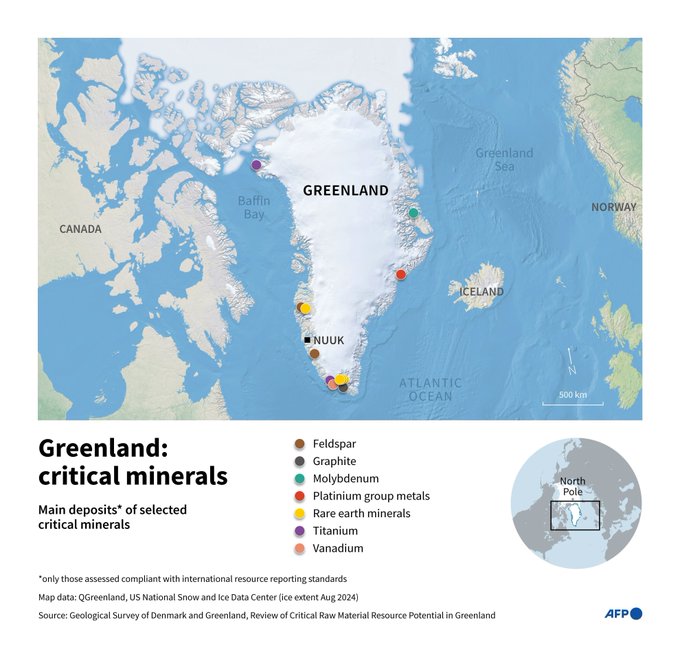
Source: X.com
Countries like the United States, China, and Russia are paying close attention to Greenland for several urgent reasons:
i) Breaking the 70% Monopoly
China currently controls more than 70% of the world's rare earth processing. Greenland is viewed as the "Great Diversifier".
Experts think Greenland can meet over 25% of the future global demand for critical metals like neodymium and dysprosium. This would enable Western nations to develop technology without relying on China.
Greenland’s Tanbreez project is estimated to contain over 28 million tonnes of rare earth minerals. This supply could last for decades without needing additional sources.
ii) Huge Energy Reserves
Most mines in the world only have "Light" rare earths. Greenland is different because 27% of its deposits at Tanbreez are Heavy Rare Earths. These are more valuable and harder to find.
Aside from metals, Greenland’s shores have great energy potential. The US Geological Survey estimates that Northeast Greenland alone holds 31 billion barrels of oil equivalent. This amount is almost the same as the entire proven oil reserves of the United States.

Recent data shows that Greenland sits on:
- 8th largest REE reserves: Approximately 1.5 million tonnes of pure Rare Earth Oxides.
- Strategic Energy: The island also holds the 8th largest uranium deposit (at Kvanefjeld), though mining it is currently restricted by local laws.
iii) The Arctic Shortcut
Greenland is the gateway to the Arctic. As the ice melts, new sea routes open up. These routes can reduce travel time between Asia and Europe.
For example, controlling Greenland means controlling the "Polar Silk Road". This route is 40% faster for shipping goods between Asia and Europe than using the Suez Canal.
iv) National Security
The island is an ideal location for early-warning radar systems and satellite tracking. It lies between North America and Europe, making it an important barrier for Western defence.
This is why some world leaders have suggested buying the island or creating strong military partnerships.
What Are The 17 Rare Earth Elements (REE) Found in Greenland?
Greenland is a Treasure Chest Beneath the Ice -
— ArchaeoHistories (@histories_arch) November 17, 2025
Underneneath Greenland’s vast, icy surface lies something unexpected: some of the richest raw material deposits on Earth.
This Arctic island isn’t just the world’s largest island; it’s a geological goldmine. Formed over billions… pic.twitter.com/BVBmQqh82H
Rare Earth Elements are a group of 17 special metals. They are usually found together in the Earth's crust. Greenland is known for having almost all of them in very high amounts. These elements are divided into two groups: Light and Heavy.
| Type | Element Names |
| Light REEs | Lanthanum, Cerium, Praseodymium, Neodymium, Promethium, Samarium |
| Heavy REEs | Europium, Gadolinium, Terbium, Dysprosium, Holmium, Erbium, Thulium, Ytterbium, Lutetium, Yttrium, Scandium |
Why These Rare Earth Elements Matter for Greenland?
While there are 17 elements, four are seen as the "Crown Jewels" of Greenland's mining potential. These are key to the green energy revolution:
- Neodymium (Nd) & Praseodymium (Pr): These materials create the world's strongest magnets. Every electric vehicle motor and wind turbine relies on them to operate.
- Terbium (Tb) & Dysprosium (Dy): These are "Heavy" rare earths. They are included in magnets to help them maintain their strength at high temperatures.
Conclusion

In conclusion, Greenland is known as a mineral-rich island because it contains a massive, untapped supply of the world's most important resources. As the thick ice keeps melting, these treasures are becoming easier to access. Today, Greenland is an important player in the future of global technology and energy.



Comments
All Comments (0)
Join the conversation