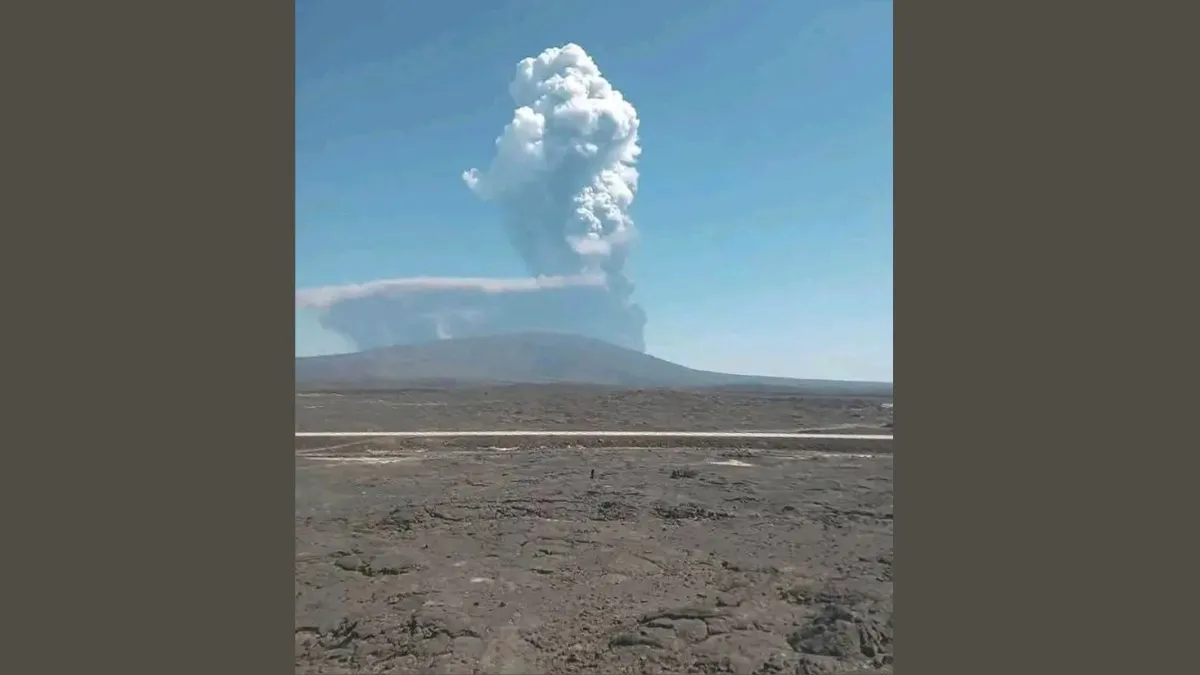
The Hayli Hubbi Volcano in Ethiopia erupted recently after being dormant for over 12000 years. The eruption created a large cloud of ash and Sulphur Dioxide (SO₂), which drifted across the Red Sea to South Asia, reaching Delhi, Haryana, Punjab, and China. As a result of this, several flights were diverted.
Where is the Hayli Gubbi Volcano located?
The Hayli Gubbi Volcano is located in the Afar Region of Ethiopia, part of the Erta Ale Range. It is a prominent volcano in the Afar region, a region known for its intense tectonic and volcanic activity. It is situated at the edge of the East African Rift, where the African and Arabian plates are slowly diverging.

Source: Britannica
What type of Volcano is Hayli Gubbi?
Hayli Gubbi is a shield volcano. Shield volcanoes are broad, gently sloping formations formed by thin, fluid lava flows, and generally shield volcanoes are less explosive, with lava spreading wide like a warrior's shield, composed mainly of dark basaltic lavas and silica-rich rocks.
What are the Cause of the eruption of Hayli Gubbi Volcano?
Shield volcanoes are known for their moderate, non-explosive eruptions caused by thin, liquid basaltic lava. The Hayli Gubbi volcano erupted in November 2025 for the first time in 12,000 years, making it a rare occurrence. During this extended inactive period, pressure built up inside the magma chamber, making the magma more viscous (sticky) and gas-rich. When it finally erupted, the trapped gases created a tremendous, explosive eruption that shot fine ash high into the atmosphere rather than a typical calm lava flow.
How did Hayli Gubbi Ash reach India?
The ash from the Hayli Gubbi volcano reached India mostly as a result of strong, high-altitude winds reaching 10-15 km high where the lower atmosphere meets the stratosphere. The presence of hot air and gases in the atmosphere helped the ash move quickly.
-
The Hayli Gubbi volcano erupted in the Afar region in Ethiopia, throwing massive amounts of ash into the skies (up to 10-15 km high).
-
The ash plume was high enough to be captured by the subtropical jet stream, which blows from west to east.
-
Due to the long-distance travel of high winds, the ash cloud spread quickly throughout the Arabian Peninsula and Arabian Sea.
-
The cloud travelled thousands of kilometres in just a few days, entering Indian airspace over northwestern regions of India such as Delhi, Haryana and Punjab.
-
Although the ash remained high in the atmosphere and rarely reached the ground, its presence at aircraft heights forced many flights in India to be cancelled or redirected for safety reasons.
Hayli Gubbi Volcano is a type of shield volcano which is located in the Afar region of Ethiopia near the East African Rift. It erupted recently for the first time in 12000 years. This is a rare, explosive eruption caused by the pressure and trapped gases in its magma chamber during its long dormant period, resulting in a large cloud of ash and sulphur dioxide. Ash was carried by high-altitude winds (subtropical jet stream) across the Red Sea and eventually reached South Asian countries, including India.



-1764939644739.jpg)

Comments
All Comments (0)
Join the conversation