Total Lunar Eclipse vs Partial Lunar Eclipse: What's the Difference?
A Total Lunar Eclipse and a Partial Lunar Eclipse are different, even though they sound similar. Let’s explore the difference between a total lunar eclipse and a partial lunar eclipse here.
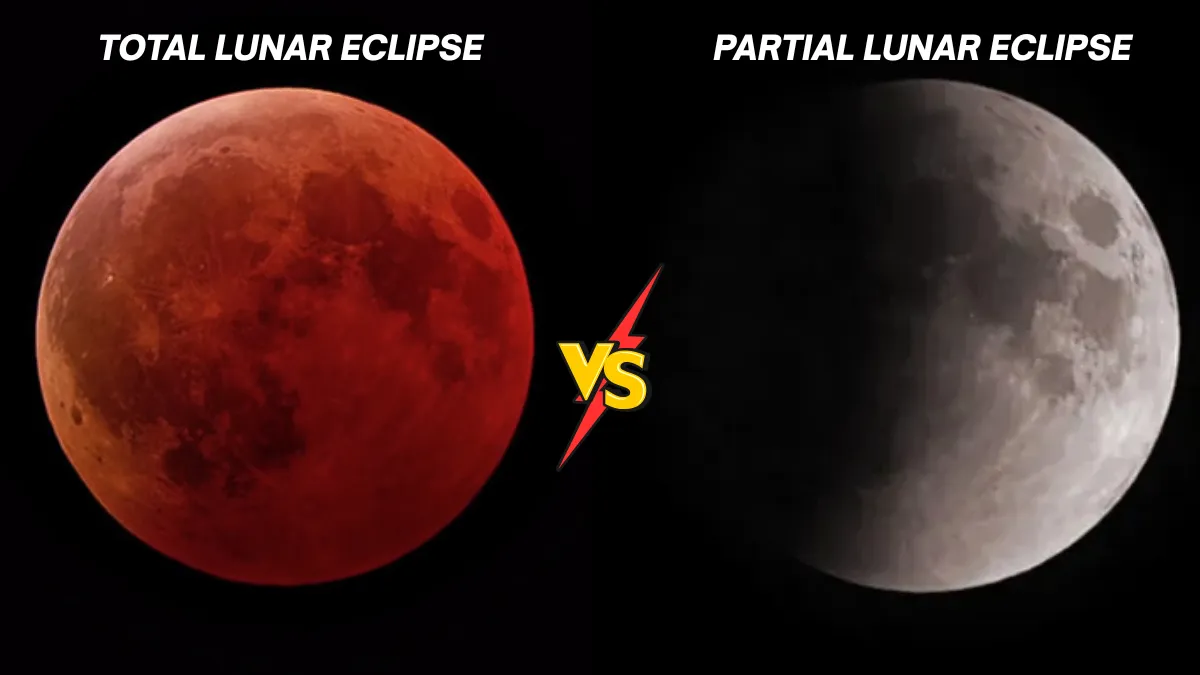
Total Lunar Eclipse vs. Partial Lunar Eclipse: Have you ever looked up at the sky and noticed that the moon looked different than usual, as if it were turning red? That is said of the eclipse of the moon.
Now that you know, this is called a lunar eclipse, or the eclipse of the moon. You might be interested to know about different kinds of lunar eclipses.
There are three types of lunar eclipses: total lunar eclipse, partial lunar eclipse, and penumbral lunar eclipse. Of the three types, the total and partial lunar eclipses are the most common.
We will be discussing the differences between a total lunar eclipse and a partial lunar eclipse here.
Let’s take you through a learning journey where you will be able to understand the difference between the two most common types of lunar eclipse.
But first, let's understand what causes a lunar eclipse.
What Causes a Lunar Eclipse?
We all know that earth orbits the Sun, and the Moon orbits the Earth. Sometimes all three heavenly bodies become perfectly aligned in a straight line, with the Earth in the middle. When this happens, Earth blocks sunlight from reaching the moon, which in turn causes an eclipse.
This phenomenon is called a lunar eclipse. Lunar eclipses always occur during the full moon phase.
Difference Between Total Lunar Eclipse and Partial Lunar Eclipse
The following are the differences between a total lunar eclipse and a partial lunar eclipse.
| Parameters | Total Lunar Eclipse | Partial Lunar Eclipse |
| Moon's position | The moon is fully inside the Earth’s umbra. | Partly inside Earth's umbra |
| Appearance | The moon appears reddish or orange-hued. | Dark shadow on the portion that is covered by the Earth’s shadow. |
| Rarity | A total lunar eclipse is very rare, as it needs perfect alignment of the sun, Earth, and moon. | A partial lunar eclipse is more common. |
What is a Total Lunar Eclipse?
A total lunar eclipse occurs when the sun, Earth, and the moon are perfectly aligned with each other in a straight line. In a total lunar eclipse, the moon moves into the umbra, which is the darkest part of the Earth’s shadow.
The shadow covers the entire moon, so no sunlight reaches it. Only some part of the sunlight passing through the Earth’s atmosphere reaches the moon and thereby dims it ever so lightly.
While colours like blue and violet, with shorter wavelengths, scatter readily and are filtered out, those with longer wavelengths, like red and orange, manage to pass through the Earth’s atmosphere. Thereby giving the moon a reddish or orangish appearance. It is also known as the Blood Moon.
The amount of dust or cloud cover significantly intensifies the moon's reddish hue.
What is a Partial Lunar Eclipse?
A partial lunar eclipse occurs when the alignment of the Sun, Earth, and Moon is not perfect. In a partial lunar eclipse, only a portion of the moon enters the umbra, or the darkest shadow of the Earth.
During a partial lunar eclipse, it may appear that a portion of the moon has turned dark, while the rest of the moon appears normal. Partial lunar eclipses are very common.
To conclude, we have explained the concept of lunar eclipse, its types, and the differences between a total lunar eclipse and a partial lunar eclipse here.
List of Solar and Lunar Eclipses in 2026, Check Dates and Time!

Mriganka Chakraborty is a seasoned digital journalist and communications professional who is currently working as Deputy Manager at Jagran Josh, where he leads the General Knowledge Section. As a subject matter expert with 8+ years of editorial experience, he has created authoritative content that is trusted by millions of readers around the world in Science, History, Geography, Polity, Economy, Sports, and Technology. His extensive expertise in these subjects enables him to present complex topics in an engaging, accurate, and reader-friendly manner to a global audience, making learning addictive and fun.
His background in a wide range of content areas and his ability to move between them make him a trusted voice to readers who want reliable, well-researched content across a variety of disciplines.
In his leisure time, Mriganka enjoys reading fiction novels and watching action and thriller movies, and cricket, which not only hone his storytelling skills but also keep his editorial vision fresh and dynamic.