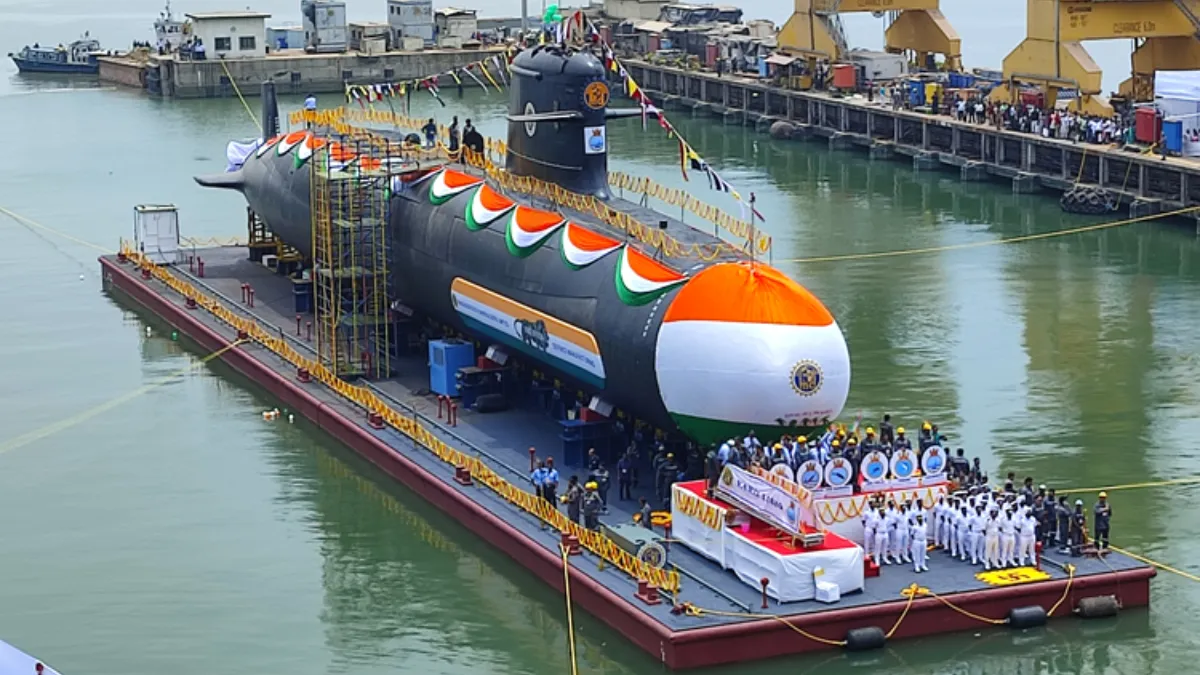
During a visit to India by German Chancellor Friedrich Merz, there is renewed momentum behind the Project 75I (P-75I) submarine deal, a ₹72,000 crore ($8 billion) program to procure 6 next-generation diesel-electric submarines having air independent propulsion to be installed at Mazagon Dock Shipbuilders Ltd (MDL) in collaboration with ThyssenKrupp Marine Systems (TKMS).
To be built based on the Type-214NG design, the Type-214NG submarines were chosen over a bid by Navantia-L&T of Spain to be able to sail stealthfully as long as possible as the Chinese/Pakistani vessels increase their undersea weapons.
The negotiations of the contract progressed to the signing in March 2026, with 60 percent of the indigenization.
What is Project P-75I?
The P-75(I) also called project-75 (India), is a planned indigenous project to build six next-generation conventional diesel-electric attack submarines with advanced air-independent propulsion (AIP), state-of-the-art sensors, weaponry and countermeasure systems.
It is an extension of the earlier Project-75 (Scorpene-class) with an aim of upgrading Indian underwater stealth, endurance and manufacturing capacity in accordance with the Atmanirbhar Bharat program.
The submarines will have fuel-cell AIP to have a long life underwater which will be a breakthrough in the transfer of marine technology and autonomy
The 75 identifier is an evolution of the Scorpene lineage.
What is the Background of Project 75?
-
Project-75, which began in 1997, aimed at updating the submarine fleet of the Navy with indigenous manufacturing under foreign cooperation.
-
Breaking down into Phase 1 (six Scorpene submarines at Mazagon Dock Ltd, MDL) and Phase II (further boats that are more indigenized).
-
MOD authorization of 24, 30+ year-old submarines, reduced to 6 because of cost.
-
2001 Naval Group (former Armaris) of France switched to ToT pivot to Scorpene design.
-
Construction: Construction start: 2006-2009; holed up by steel procurement, infrastructure.
-
Deliveries: INS Kalvari (2017) INS Vagsheer (2025); all AIP-retrofittable.
-
P-75(I) RFP opened and issued 2021; MDL-TKMS shortlisted 2025.
What are the Features of Project-75 (India)?
P-75(I) submarines are the state-of-the-art diesel-electric SSKs:
Stealth Features:
-
High level of acoustic absorption, low radiation noise.
-
Tube launched anti-ship missiles (SM-39), land-attack.
-
Better sonars, optronics, electronic warfare packages.
The Air Independent Propulsion (AIP):
-
Fuel-cell; can be submerged 2-3 weeks (diesel 48 hrs).
-
Quiet mode decreases detection at patrols.
Indigenisation:
-
45 per cent first - 60 per cent last boat; MSME ecosystem spares.
-
Greater hull than Scorpene to incorporate AIP.
-
Dimensions: length of, say, 80m, 2,200 tonnes surfaced.
What are the Objectives of Project 75I (P-75I)?
Introduced through 2021 RFP through Strategic Partnership Model, P-75I deals with the dwindling Navy fleet (16 ageing boats vs. China 60+). Key specs:
-
AIP (Fuel-Cell): 2-3 weeks submerged ( vs. 48 hrs conventional).
-
Armament: Torpedoes, SM-39 missile, land-attack cruise missile.
-
Sensors Advanced blue-water optronics and sonar.
-
Timeline: First boat 2032-34; all by 2040.
-
Construction: MDL, TKMS ToT; connecting bridges to indigenous P-76/P-77.
Read more: Which River Is Called the Rocky River of India?
Fleet Modernization Roadmap
| Project | Partner/Sub | Status/No. |
| P-75I | TKMS/Type-214NG | Negotiations (6 boats) |
| P-75 (Scorpene) | Naval Group | 6 delivered; 3 paused |
| P-76 | Indigenous | Design phase |
| Nuclear SSK | DRDO | Trials 2027 |
Why Type-214NG Over Competitors?
-
AIP proven: TKMS PEM fuel cells (U-212A ops); competitors not as mature.
-
Lifecycle Edge: Lower risk/cost than S-80.
-
MDL-TKMS MoU (2024) ensures ToT.
-
P-75I was followed by a pause in the priority of Scorpenes.
What is the Economic Status of this project?
-
Indigenization: 45% start → 60%; supply chain for 1,000+ MSMEs.
-
Jobs: 20,000 direct; MDL capacity doubles.
-
Cost: ₹12,000 Cr/sub incl. spares/training.
P-75I boosts Indian sea power, revisiting 1971, and looking ahead to 2047 blue-water goals.



-1768322786819.jpg)

Comments
All Comments (0)
Join the conversation