List of Tectonic Plates in the World
The movement of the tectonic plates influences the movement of Earth's continents. The Earth we see today, about 336 million years ago, was only one supercontinent known as Pangea. In this article, we will look into the list of all major and minor tectonic plates in the world.
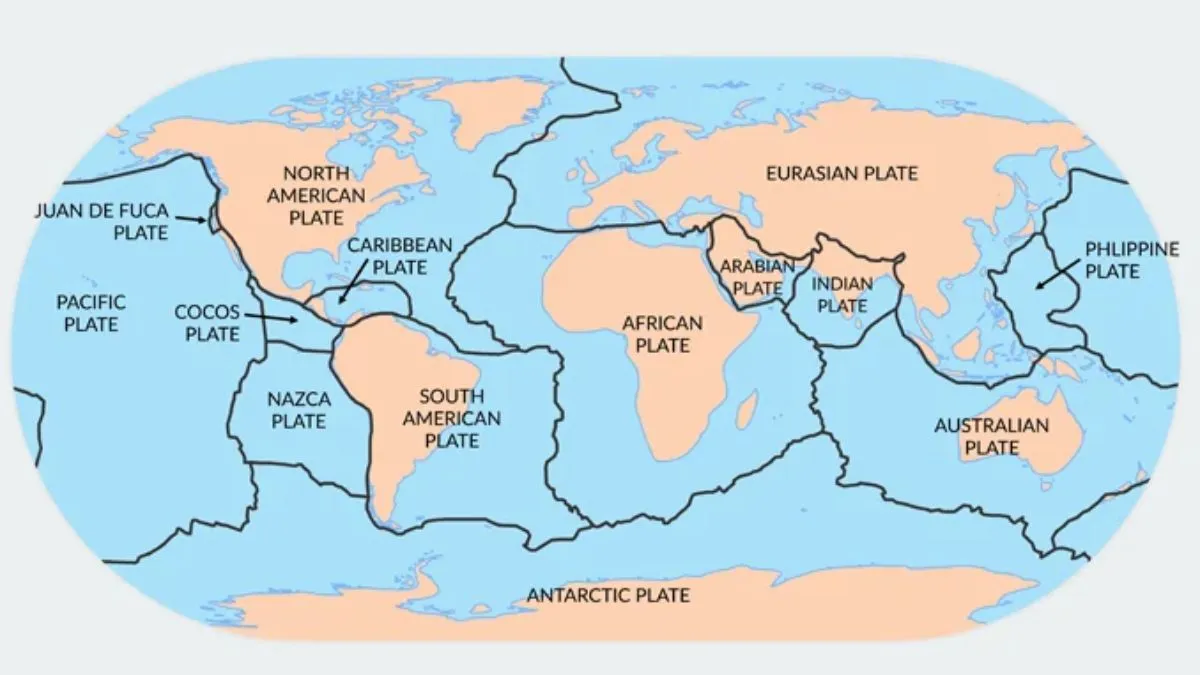
On 8 June 2026, an offshore earthquake with a magnitude of 7.8 hit the southern Philippines. The powerful earthquake also caused a tsunami of about 3 feet onto nearby coasts. The epicentre of the quake was located about 32 km offshore, southwest of Maasim town in Sarangani province. The quake occurred at a depth of 33 km. It is to be noted the Philippines is often hit by earthquakes and volcanic eruptions due to its location directly on the Pacific 'Ring of Fire', where several tectonic plates converge.
The movement of the tectonic plates influences the movement of Earth's continents. The Earth we see today, about 336 million years ago, was only one supercontinent known as Pangea. And behold, the first supercontinent that existed about 3.6 billion years ago was Vaalbara. But the forces of moving tectonic plates subsequently shattered these supercontinents into several continents. These tectonic plates are constantly in motion, which causes earthquakes, rift valleys, oceans, and mountains.
What is Plate Tectonics Theory?
Tectonic activity began about 4 to 3.2 billion years ago. The scientific theory of tectonic plates suggests that Earth's lithosphere is made up of a number of large tectonic plates, which have been slowly moving since 3 to 4 billion years ago.
The theory is based on the concept of continental drift, a concept proposed by a German meterologist and geophysicist Alfred Wegener in 1912. Aflred Wegener is known as the 'Father of Plate Tectonics'. The concept came to be accepted by geoscientists after seafloor spreading was proposed by Harry Hess in the mid to late 1960s.
What is Earth's lithosphere?
Earth's lithosphere is the rigid outer shell of the planet comprising the Earth's crust and upper mantle. It is broken into seven major tectonic plates and other minor and micro plates.
The lithosphere exists as separate and distinct tectonic plates, which float on top of the fluid-like asthenosphere.
The motion of these tectonic plates determines the type of plate boundary or tectonic fault: convergent, divergent, and transform. Plate motions range up to a typical 10-40 mm/a (about as fast as fingernails grow) to about 160 mm/a (about as fast as hair grows).
The tectonic plates are around 100 km (60 miles) thick and consist of lithospheric mantle overlain by either of two types of crustal material: oceanic crust and continental crust. The continental crust is considerably thicker than oceanic crust.
Earthquakes, volcanic activity, oceanic trenches, and mountain formation occur along plate boundaries. The majority of the world's active volcanoes occur along plate boundaries, with the Pacific Plate's Ring of Fire being most active and most widely known.
Types of Tectonic Plate Boundaries
Heat dissipating from the Earth's mantle first put the tectonic plates in motion. When different plates meet, they collide, slide across each other or break, thus generating earthquakes or volcanic activity.
Tectonic plates are able to move because of the relative density of oceanic lithosphere and the relative weakness of the asthenosphere. Dissipation of heat from the mantle is acknowledged to be the original source of energy driving plate tectonics.
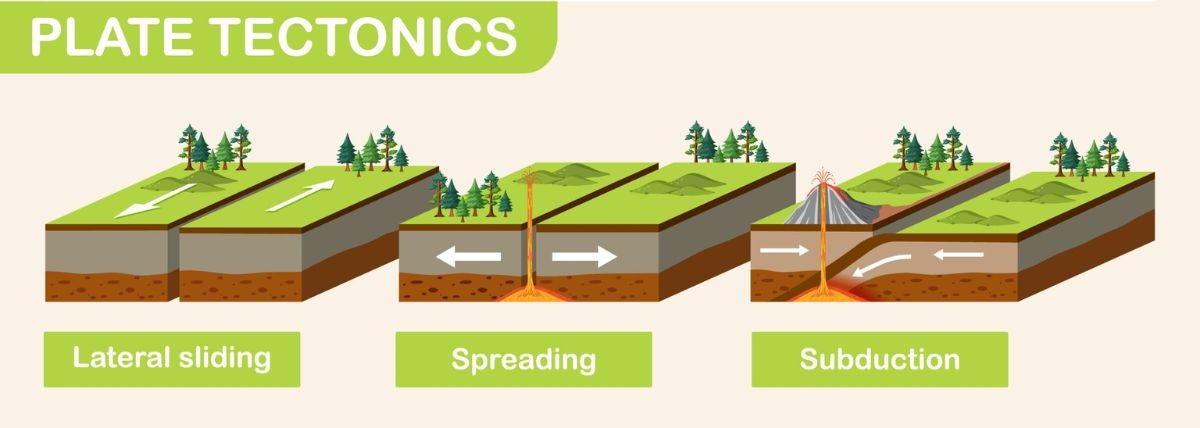
Based on the way the tectonic plates move relative to each other, there are three types of plate boundaries:
Convergent boundaries
Convergent boundaries occur where two plates slide towards each other forming either a subduction zone (if one plate moves underneath the other) or a continental collision (if the two plates contain continental crust). The nature of a convergent boundary depends on the type of lithosphere in the plates that are colliding.
When an oceanic plate collides with a continental plate, the oceanic plate thrusts underneath the continental plate forming a subduction zone.
When two continental plates collide, the plates either compress or overrides the other. Either wya, this action will create extensive mountain ranges. One such example is where the Indian plate meets the Eurasian plate, resulting in the Himalayas and the Tibetan Plateau.
When two oceanic plates converge, the denser and older oceanic plate is pushed beneath the lighter place into the mantle causing a subduction zone. This action lead to formation of an island arc. Notable examples are the Mariana Islands in the western Pacific or the Aleutian Islands in Alaska.
Divergent boundaries
Divergent boundaries occur when two plates spreading apart from each other causing a fracture in the land thus, giving way for the magma to rise from the underlying mantle and fill the space.
On land, divergent boundaries can cause rift valleys while on the ocean floor, it forms mid-ocean ridges.
Notable oceanic ridge examples include the Mid-Atlantic Ridge, and continental examples include the famous East African Great Rift Valley.
Transform boundaries
Transform boundaries occurs when plates slide parallely or grind against each other forming faults. However, geologically the plates cannot simply glide past each other due to friction.
Rather, stress builds up in both plates, eventually reaching a threshold of rocks on either side of the fault and releasing the accumulated energy in the form of earthquakes.
Notable examples include the San Andreas Fault found in the western coast of North America. Other examples include the Alpine Fault in New Zealand and the North Anatolian Fault in Turkey.
What are the 7 major types of tectonic plates?
Let us learn the seven major tectonic plates in the world:
1. Pacific Plate: Largest of all, it is an oceanic plate under the Pacific Ocean, spanning across 103,300,000 sq km. Famous for the highly active Pacific 'Ring of Fire' belt.
2. North American Plate: A continental plate under North America, Greenland, and extending into Siberia, spanning across 76,000,000 sq km.
3. Eurasian Plate: A continental plate covering most of Asia and Europe, spanning across 68,000,000 sq km.
4. African Plate: A continental plate under Africa and extending to the surrounding Atlantic and Indian oceans, covering an area of 61,300,000 sq km.
5. Antarctic Plate: A continental plate under Antarctica and surrounding ocean floor, covering an area of 61,000,000 sq km.
6. Indo-Australian Plate: A continental plate formed by the fusion of the Indian and Australian plates, but mostly covering Australia. It covers an area of 59,000,000 sq km.
7. South American Plate: A continental plate covering South America and extending into the Atlantic Ocean, spanning 44,000,000 sq km.
List of minor tectonic plates in the world
Below is the names of minor tectonic plates in the world:
1. Arabian Plate
2. Caribbean Plate
3. Juan de Fuca Plate
4. Cocos Plate
5. Nazca Plate
6. Philippine Sea Plate
7. Scotia Plate

Roopashree Sharma is an experienced broadcast journalist with over 7 years of experience, specialising in beats including geopolitics, defence, and general awareness. She has worked in the roles of correspondent and producer for leading media houses, including Zee, WION, and Economic Times. Currently serving as Deputy Manager – Editorial at Jagran New Media, she produces explainer articles and videos for the General Knowledge (GK) section of the Jagran Josh (English) portal. For inquiries, contact her at roopashree.sharma@jagrannewmedia.com.


