Key Points
- Saturn's icy rings, first observed in 1610, span 282,000 km and are 10-100m thick.
- Voyager 1 discovered Jupiter's faint, dusty rings in 1979, extending ~226,000 km.
- Voyager 2 found Neptune's 5 rings + arcs in 1989, composed of dark silicate/organic dust.
Planetary rings are one of the most beautiful phenomena in the Solar System. They are created as a result of the orbiting debris trapped into the gravitational pull of a planet.
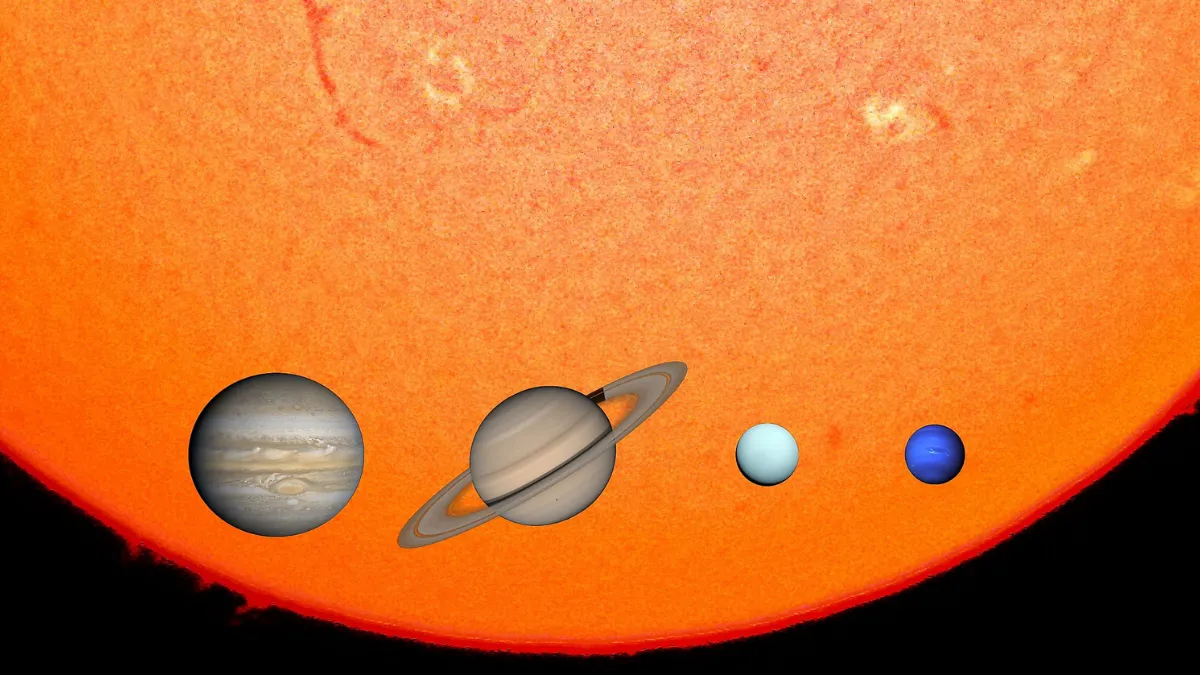
The ring systems of the four gas giant planets: Jupiter, Saturn, Uranus, and Neptune exist and none of the terrestrial planets (Mercury, Venus, Earth, Mars) have these because of the closeness of these planets to the Sun and their absence of moons captured.
The iconic icy rings of Saturn command the imagination, however, recent missions have shown the various dusty bands orbiting each of the outer worlds.
Confirmed Ringed Planets
| Planet | Discovery Mission/Year | Key Characteristics |
| Jupiter | Voyager 1 (1979) | Faint, dusty (Main, Halo, Gossamer); ~226,000 km extent; no ice, moon-derived dust |
| Saturn | Galileo (1610); Voyager/Cassini | Spectacular, icy (7 main A-G + ringlets); 282,000 km diameter; 10-100m thick |
| Uranus | Kuiper Observatory (1977); Voyager 2 | 13 narrow/dark rings; dusty/icy; ~250,000 km span |
| Neptune | Voyager 2 (1989) | 5 main rings + arcs; dark/dusty; ~120,000 km extent |
Source: Planetary Names
What are these Planet Rings Made Up Of?
According to the Jet Propulsion Laboratory (JPL) from NASA and mission archives, planet rings are made up of millions of particles; ice, dust, rock, whose diameter ranges between micrometers and meters. It orbits in flat disks around the Roche limit (where tidal forces tear moons apart).
All four of the eight planets (50 percent) with rings confirmed to be there, are those 100,000s km across, yet mere meters-km thick. The complexity of NASA Voyager, Galileo, Cassini, and Hubble missions was revealed in their braided sub-structures, or shepherd moons within them.
Saturn's Rings
Saturn’s Rings can be seen since the time the telescope of Galileo (1610) looked at it (looking like ears).
It is made up of 7 primary rings (A-G) together with thousands of ringlets which run along a diameter of 282,000km and are 10-100m thick.
It is almost pure water ice (99% reflectivity); the size of the particles are dust-to-boulders.
Cleopatra Cassini (2004-17) disclosed dynamic characteristics:
| Feature | Description |
| Encke Gap | 325km wide; moon Pan orbits within |
| Keeler Gap | 35km; Daphnis creates waves |
| Spokes | Dark radial features (electrostatic?) |
| F Ring | Braided by Prometheus/Pandora |
Weakest, dustiest:
Found 1979 (Voyager 1): There are four elements (Halo, Main, Amalthea/Thebe Gossamer) covering 226,000km thick Main ring.
Metis/Adrastea moonlet dark rocky dust hits; ice none was confirmed by Galileo orbiter (1990s). It is invisible from Earth.
Uranus' Rings
Source: NASA Science
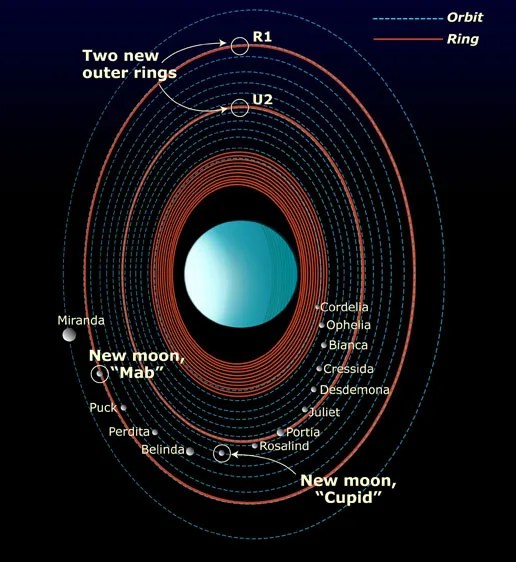
Dark, narrow: 13 verified rings (a-n, Greek letters); 1977, through stellar occultation (Kuiper telescope). Voyager 2 (1986) pictured 11, Hubble added λ, ν.
Distance to planet 38,000-98,000 km; dust of carbon (5% reflectivity). Tilted 98deg with Uranus
| Ring | Width (km) | Notes |
| ε (Epsilon) | 20-96 | Brightest, eccentric |
| δ (Delta) | 4-11 | Narrowest |
| η, ζ | 30 | Dusty |
Neptune's Rings
Source: NASA Science
-
Clumpy, dynamic: Voyager 2 (1989) found 5 rings + arcs (Galle, Le Verrier, Lassell, Arago, Adams).
-
Span 39,000-119,000 km; dark silicate/organic dust. Adams ring arcs (Fraternité, Égalité, Liberté) confined by Galatea moon.
-
Unique: Incomplete rings; electrostatic charging causes clumps.
Ring Formation Theories
Rings likely originate from:
-
Disrupted moons within Roche limit (~2.44 planetary radii)
-
Moon collisions ejecting debris
-
Captured comets/asteroids
-
Primordial remnants from planet formation
Shepherd moons (e.g., Saturn's Pan) gravitationally confine particles. Gas giants retain rings; inner planets' solar gravity clears them.
Comparisons of the Planet Rings
| Planet | # Rings | Diameter (km) | Composition | Visibility | Discovery |
| Saturn | 7+1000s | 282,000 | Ice (99%) | Naked eye | 1610 |
| Jupiter | 4 | 226,000 | Rocky dust | Spacecraft | 1979 |
| Uranus | 13 | 98,000 | Carbon dust | Telescopes | 1977 |
| Neptune | 5+arcs | 119,000 | Silicate dust | Spacecraft | 1989 |
Beyond Planets: Dwarf planet Haumea (2014 ring); centaur Chariklo (double rings). Exoplanet J1407b has Saturn-scale rings.
Read more: Which City Is the Tourism Capital of India?
Enter your Blink text here...



-1769620555186.jpg)

Comments
All Comments (0)
Join the conversation