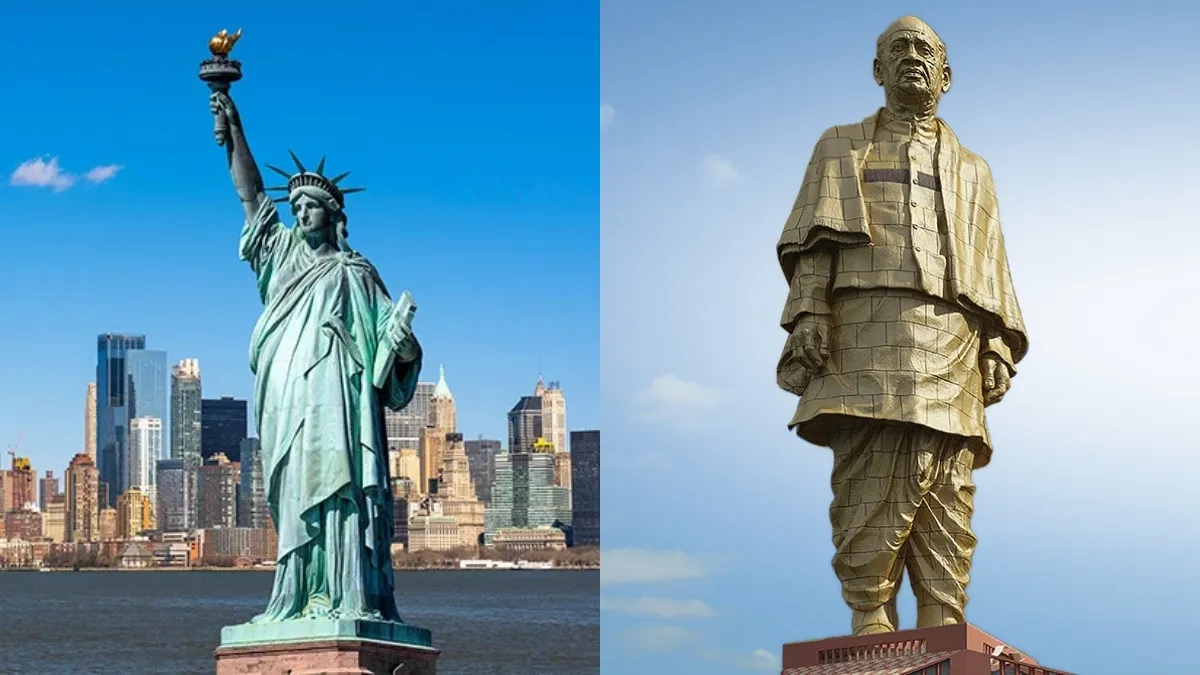
Statue of Liberty vs Statue of Unity: Statue of Liberty represents political freedom and democracy, Statue of Unity represents national integration & strong leadership. Statue of Liberty and Statue of Unity are two of the world’s most famous colossal statues in the USA and India. Both monuments attract millions of visitors and symbolize national identity and values in different ways. Read on to know the difference between Statue of Liberty vs Statue of Unity, down to their height, location, symbolism, and era.
Statue of Liberty vs Statue of Unity: What’s the Difference?
At the simplest level, the Statue of Liberty is an older, shorter symbol of freedom in the United States, while the Statue of Unity is a newer, taller monument honoring a national leader in India.
| Key comparison point | Statue of Liberty | Statue of Unity |
| Country and location | USA, New York Harbor | India, near Kevadia, Gujarat |
| Approximate height (statue + base) | About 93 meters | About 182 meters |
| Year of completion | 1886 | 2018 |
| Main material | Copper | Bronze‑clad reinforced concrete |
| Person or idea honored | Liberty / friendship with France | Sardar Vallabhbhai Patel, Indian unity |
Statue of Liberty
The Statue of Liberty was a gift from France to the USA, marking freedom and friendship. Its placement in New York Harbor historically greeted ships carrying immigrants to Ellis Island. Unveiled in 1886, the colossal copper icon—designed by Frédéric Auguste Bartholdi—stands 305 feet tall, symbolizing hope for over 12 million newcomers seeking the American Dream.
Statue of Unity
The Statue of Unity was built by India to honor Sardar Patel’s role in uniting the country after independence. The Indian statue is roughly twice as tall, making it one of the tallest statues in the world. The Unity Statue includes museums and exhibitions focused on Patel’s life and India’s independence history.
Statue of Liberty vs Statue of Unity: What Does Each One Represent?
The Statue of Liberty represents political freedom, democracy, and welcome to immigrants arriving in the United States. The Statue of Unity represents national integration, strong leadership, and modern development aspirations in India.
-
The Statue of Liberty’s torch and crown symbolize enlightenment and the path to liberty for people seeking a new life.
-
The Statue of Unity depicts Sardar Patel walking forward, symbolizing determination and the effort to bring hundreds of princely states together.
Both monuments are used in school lessons, documentaries, and national celebrations to reinforce civic values and pride.
Statue of Liberty vs Statue of Unity: Which Is Taller and Easier to Visit?
In terms of height, the Statue of Unity is clearly taller, while the Statue of Liberty is more globally recognized and located closer to a major world city.
-
Height: Statue of Unity is about 182 meters tall, roughly double the overall height of the Statue of Liberty at around 93 meters.
-
Statue of Liberty is reached by ferry from New York City or New Jersey, making it easy to include in urban trips.
-
Statue of Unity requires travel to Gujarat in western India, often via Ahmedabad or Vadodara, plus a road journey to the site.
Read About | What is the Capital of Delaware?
Conclusion
Statue of Liberty vs Statue of Unity: what’s the difference is mainly about era, purpose, and scale. One is a 19th‑century symbol of freedom and welcome in the USA; the other is a 21st‑century tribute to unity and leadership in India. For readers, the key takeaway is that both monuments are powerful in their own way, and comparing them helps explain how nations express their stories through iconic structures.

-1765968337460.jpg "Which Country Invented Cricket?")

-1765974587290.png)


Comments
All Comments (0)
Join the conversation