Bhutan Glacial Lake Outburst Causes Flood Alert in Bengal, Assam: What is GLOF, Why is India at Risk, Why is it Recurring in Himalayas?
So far, India has witnessed several devastating GLOF-related disasters. In June 2013, flooding involving the Chorabari Lake near Kedarnath caused extreme destruction in Uttarakhand. In October 2023, the South Lhonak Lake outburst in Sikkim triggered deadly flooding along the Teesta River, causing massive loss of life and infrastructure damage.
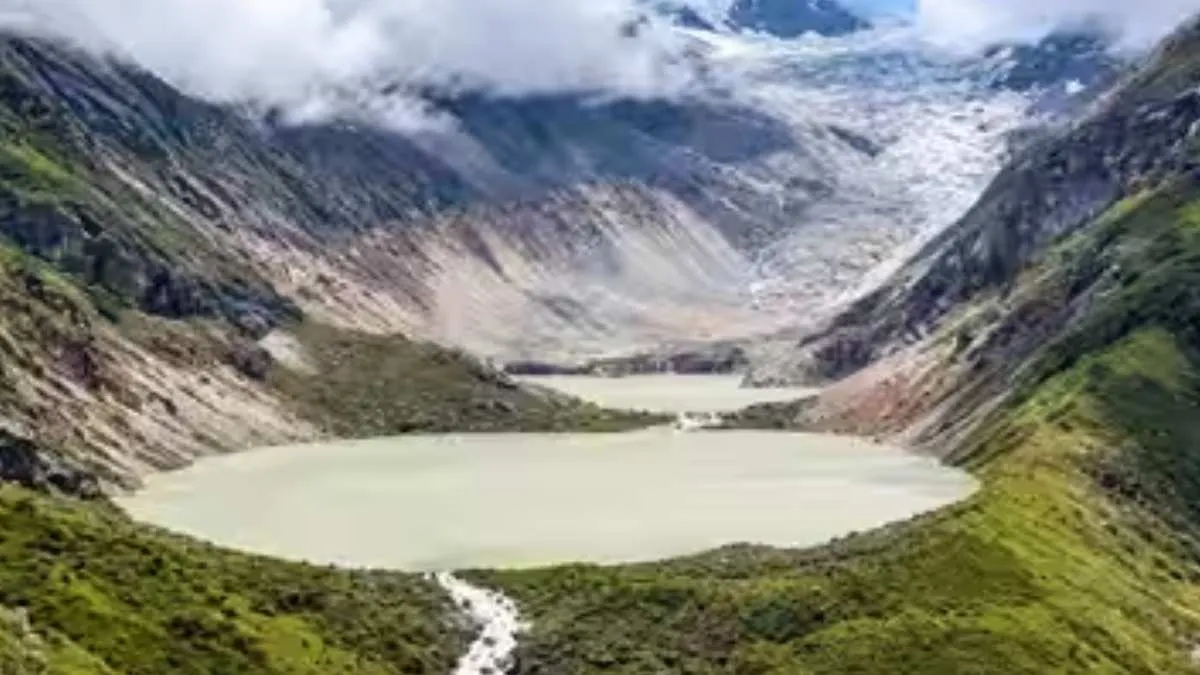
A glacial lake outburst flood (GLOF) at Shintaphu Lake in Bhutan's Gasa district on October 29, has reignited concerns about the soaring threat of climate-linked disasters across the Himalayan region, especially in downstream areas of India. The incident caused instant high alerts across low-lying districts in Assam and West Bengal. It has also underscored the risks of communities, infrastructure and river systems to sudden floods caused by melting glaciers and uneven mountain lakes.
The recent incident trigerred the instant release of water sent floodwaters downstream through the Mo Chhu river system, thus disrupting infrastructure at the famous Gasa Tshachu natural hot spring, which had been evacuated, and thus no casualties were recorded.
Why is GLOF?
A GLOF unfolds when water stored in a glacial lake is instantly released after its natural barrier, commonly comprising ice or loose rocks and sediment, collapses. The consequent flood can shift instantly through mountain valleys, carrying enormous quantities of water, rocks and debris and triggering massive harm downstream.
Why Are Glacial Lake Outburst Floods Dangerous?
Glacial lakes occur when glaciers retreat or melt, thus causing left-over depressions that slowly fill with water. These lakes are commonly held back by natural barriers comprising ice, rocks and loose sediment, which can become unstable over time.
VIDEO | Delhi: On the sudden flooding in Bhutan following a Glacial Lake Outburst Flood (GLOF), NDRF DG Piyush Anand says, “We have received information from there, and, as we normally do in such situations, we are coordinating with all the agencies concerned. The Prime Minister and the Home Minister have given clear instructions that we must adopt a whole-of-government approach. We are in touch with all the relevant agencies, including the CWC and IMD, as well as others involved. We have alerted some of our teams. However, according to the information received so far, there is no immediate cause for concern. We remain on alert and are prepared to respond if the situation worsens.” (Full video available on PTI Videos - https://t.co/bIyFWTfmBd)
— Press Trust of India (@PTI_News) October 30, 2026
A instant breach can release millions of cubic metres of water within a minimal period. The resulting flood shifts rapidly through mountain valleys, damaging roads, bridges, buildings and hydropower infrastructure.
Several factors can trigger a GLOF
Heavy rainfall and swift snowmelt.
Earthquakes that weaken natural barriers.
Landslides and rockfalls entering glacial lakes.
Ice avalanches that displace enormous water.
Soaring temperatures that escalate glacier melting.
On top of it, Climate change is making the situation a pressing concern. Rising temperatures are accentuating glacier retreat across the Himalayas, thus forming new glacial lakes and the escalation of present ones.
Why Are India and Bhutan on Alert?
After the Bhutan incident, authorities issued flood alert for vulnerable zones in West Bengal and Assam. Districts including Alipurduar, Jalpaiguri, Cooch Behar and Dhubri have been placed under bolstered surveillance.
The Sankosh River, which is linked to Bhutan's Mo Chhu and Pho Chhu river systems, eventually joins the Brahmaputra in Assam. Resultantly, a quick rise in water levels could impact communities near its banks. In response, Authorities have implemented disaster response arrangements and are monitoring river levels.
Why is India at risk due to lakes and floods?
India's risk is derived from its geography, geology, climate and the concentration of people and infrastructure in Himalayan river valleys.
The Indian Himalayan region houses thousands of glaciers and glacial lakes. As temperatures increase, glaciers are retreating, thus establishing new lakes and expanding existing ones. This boosts the possible volume of water that could be released during an outburst.
The threat is especially massive in Sikkim, Himachal Pradesh, Uttarakhand, Arunachal Pradesh, Jammu and Kashmir and Ladakh.
A 2020 study published in Water Resources Research reviewing 329 glacial lakes in the Indian Himalayas, discovered that around 22% posed high or very high hazard levels, thus signalling the possiblity of an outburst and its possible downstream consequence.
Why are Himalayan Disasters and Floods Recurring?
So far, India has witnessed several devastating GLOF-related disasters. In June 2013, flooding involving the Chorabari Lake near Kedarnath caused extreme destruction in Uttarakhand. In October 2023, the South Lhonak Lake outburst in Sikkim triggered deadly flooding along the Teesta River, causing massive loss of life and infrastructure damage.
Experts have repeatedly emphasised on persisting glacier monitoring, enhanced early-warning systems and disaster preparedness.
Why Bhutan has so many Dangerous Lakes?
Coming back to the recent outburst, Bhutan's mountainous terrain, glaciers and steep river valleys make it particularly susceptible to such outbursts. According to the country's National Centre for Hydrology and Meteorology, Bhutan has 567 glacial lakes, of which 17 have been classified as potentially dangerous.

At Jagran Josh, she specialises in writing explainers and analytical stories on international news and current affairs. Over the years, she has developed strong expertise in leveraging digital and multimedia tools, along with SEO best practices, to enhance the speed, reach, and impact of her stories.