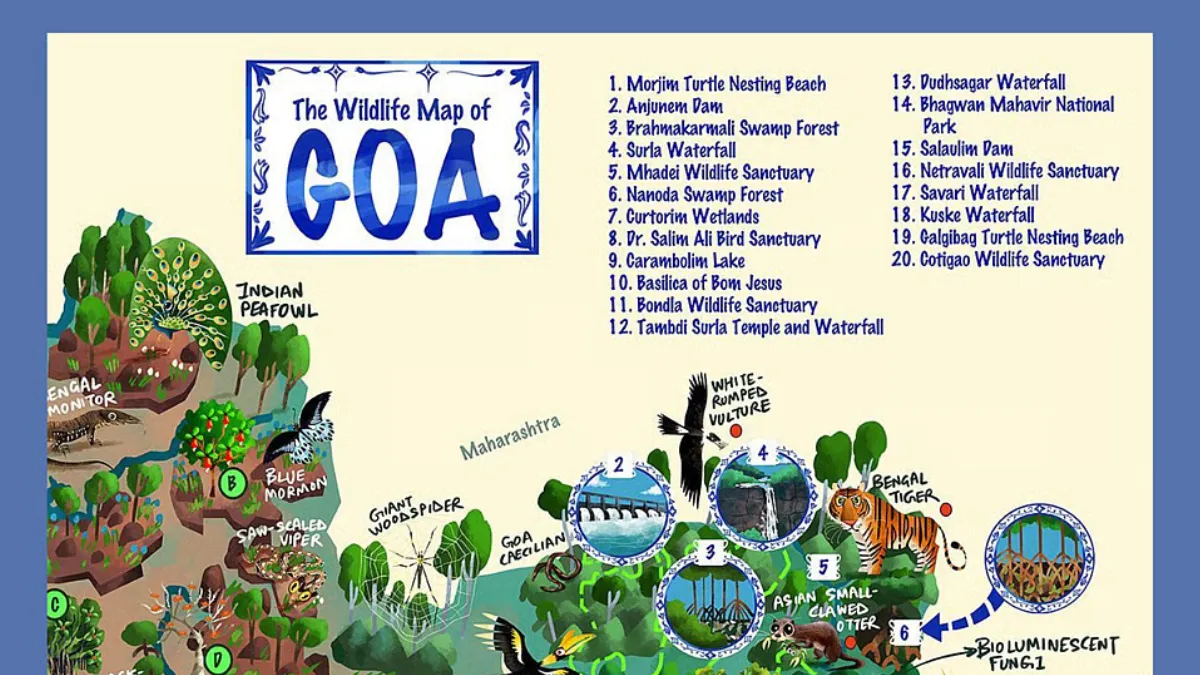
The attempt to combine environmental consciousness with cultural heritage among school going children is made in Goa with the first biodiversity and cultural map created by WWF India.
Revealed on February 13-14, 2026, in the International Centre Goa, this child-oriented visual guide will include 48 representatives of common species and traditional forms of art, and will be distributed in print and electronic copies, free of charge to schools.
The map identifies 48 species that can be found in the various ecosystems of Goa such as birds, mammals, reptiles, marine species, mangroves and insects and some of the species are catfish, tigers, mangrove varieties like Rhizophora mucronata and Avicennia officinalis.
It specifically aims at ordinary meetings in localities, mangroves, coastal waters, and forests of the Western Ghats so as to promote local identification and interest.
WWF Goa coordinator Aditya Kakodkar stressed the need to tie map images to actual observations and created a sense of curiosity but not the rarities that belonged to researchers.
What are the Cultural Factors Integrated in this Map?
It combines ecology and identity and describes kaavi art (red laterite murals), Kunbi female attire, Ghoddemodni folk dance, and crocodile veneration (manngetapnni). The folk-indica style of artist Sudarshan Shaw does not use cartoons, and does not demean Goan traditions; this has been found to be appealing to students.
How is it related to NEP 2020?
Coupled with the Class VI experiential/vocational learning of National Education Policy, WWF provided 450 teachers in government/aided schools with training on links between the environment and vocation.
This wall map transforms education as a disjointed event (e.g. scoped bird views) into everyday conversations, which produce biodiversity dialogues.
Goa's Biodiversity Context
Goa is nestled in the Western Ghats and coastal areas and has mangroves essential in protection/fisheries, a variety of avifauna and endangered species.
Earlier efforts have been the 2023 atlas of Mayem village (250 pages on flora/fauna in the area) and a push at 2026 by CM Pramod Sawant towards 191 panchayat atlases, with Goa subsequent to Himachal Pradesh.
In 2023, National campaigns update People Biodiversity Registers (PBRs) and use them as the basis of community-led conservation.
What is the Conservation Significance of this Map?
The device overcomes the urbanization menaces to the nearby pulses, vegetables and medicinals, fostering grassroots keenness to land grabbing. It links Goa to SDGs by making it a model of biodiversity by sparking youth involvement, which enhances eco-tourism and cultural pride.


-1770812153049_t.webp)
Comments
All Comments (0)
Join the conversation