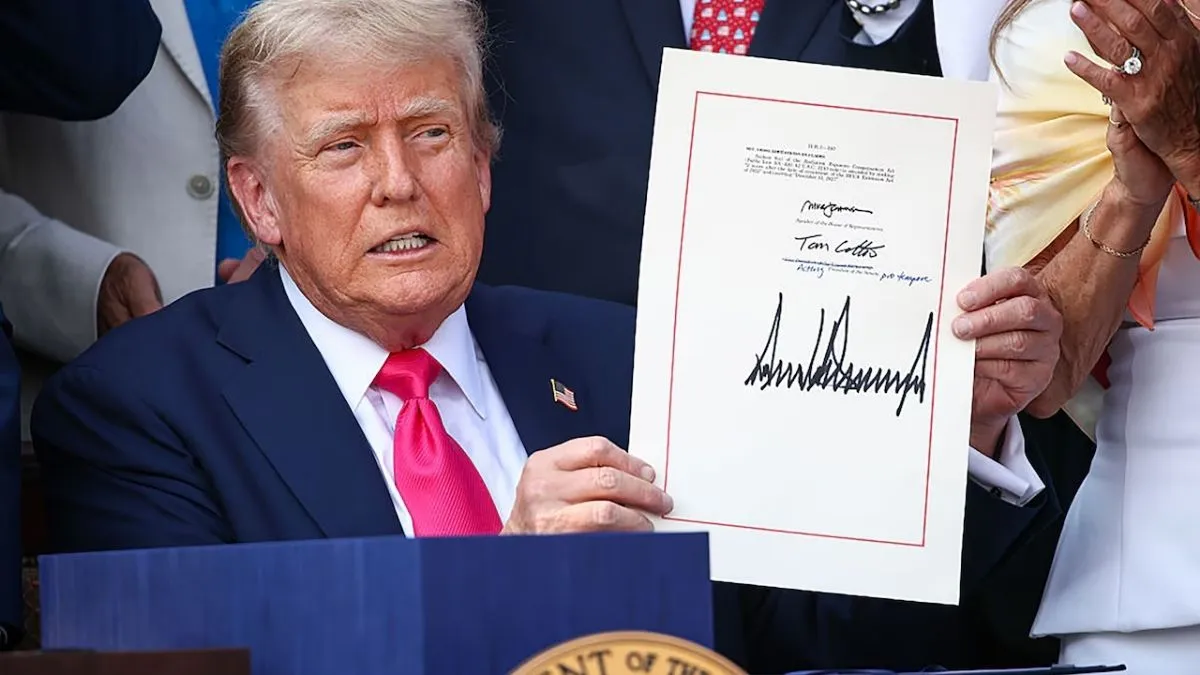
Do you know that the One Big Beautiful Bill permits Trump Accounts to be established for American children who have not reached age 18? After knowing this, a wave of questions has come across following the announcement that tech billionaire Michael Dell and his wife, Susan, will donate $6.25bn to help fund “Trump accounts” for millions of US children.
The initiative was created under President Donald Trump’s sweeping tax and spending package. It is known as the One Big Beautiful Bill, which promises to give young Americans an early foothold in long-term investing. Yet despite high-profile endorsements, many practical details remain unclear.
What Are Trump Accounts?
Trump accounts are tax-advantaged investment accounts designed for children aged 18 or under. They will officially launch on 4 July 2026. Under the legislation, every child born between 1 January 2025 and 31 December 2028 will automatically receive a $1,000 government seed deposit, invested in a low-cost stock index fund. The aim is to expose children early to the benefits of compounding and long-term market growth.
Any parent or guardian of a child with a valid social security number can open and manage the account once the programme goes live.
Who Qualifies for Trump Accounts in 2026?
Children qualify for Trump accounts if they meet the age and birthdate requirements outlined in the One Big Beautiful Bill. Eligibility is determined as follows:
| Eligibility Category | Requirements | Details |
| Age Requirement | Under 18 | The child must be 18 years old or younger when the programme launches. |
| Birth-Date Requirement (Government Seed Money) | Born 1 Jan 2025 – 31 Dec 2028 | Eligible for the $1,000 government deposit into a new Trump Account. |
| Eligibility for Dell $250 Contribution | Born before 1 Jan 2025 and aged 10 or under | Must live in a U.S. ZIP code with a median income ≤ $150,000 to qualify for the Dell family’s philanthropic grant. |
| Citizenship / Identification | Valid U.S. Social Security Number | Required to open or manage a Trump Account. |
| Guardian Requirement | Parent or legal guardian | Must create and oversee the account until the child turns 18. |
| Income Requirement | None | Household income does not affect eligibility for the government’s $1,000 deposit. |
| Contribution Eligibility | Anyone | Parents, family, friends, employers, charities and philanthropists may contribute (up to $5,000/year per child; some entities have no limit). |
(Source Note: Information in the above eligibility table is compiled from official White House briefings (June & August 2025), the One Big Beautiful Bill legislative outline, U.S. Treasury and IRS updates released on 2 December 2025, and reporting from reputable outlets including The Guardian, Reuters, and CNBC on Trump Accounts and the Dell family’s $6.25bn contribution.)
How will the money Be Managed?
Funds will be invested in diversified, low-cost index portfolios. Initially, accounts will be created and overseen by the US Treasury’s designated financial agent. Later, families may transfer balances to participating brokerage firms. Investment earnings will grow tax-deferred, similar to a traditional Individual Retirement Account (IRA).
Check Out: What is Naturalization? History, Requirements, Benefits & Process
When Can Money Be Withdrawn?
Withdrawals are restricted until the child turns 18. At that point, the account converts into a standard IRA and early-withdrawal penalties may apply, except in approved cases such as higher-education costs, a first-home deposit, job training, or starting a business. Families are awaiting further IRS guidance on taxation and eligibility for philanthropic contributions.
Will Trump Accounts Reduce Child Poverty?
Analysts have various predictions and supporters argue that early investing boosts long-term financial security. This will teach children the fundamentals of saving and giving families a long-term asset. Moreover, the critics highlight that the programme arrives alongside significant cuts to social support schemes. This gives low-income house a struggle to contribute additional funds and thus benefit meaningfully. Some experts fear the policy may functions more as a long-term tax shelter for wealthier families than as an equalising force.
You may also like to read: List of Top Online Law School Programs in U.S. (2026)
Still, the promise of automatic enrolment and high-profile philanthropic support suggests the scheme could give millions of children an entry point into wealth-building, even if its broader economic impact remains uncertain.


-Don-Shula,-Bill-Belichick,-Chuck-Noll-1764934473361.jpg)

Comments
All Comments (0)
Join the conversation