Show Key Points
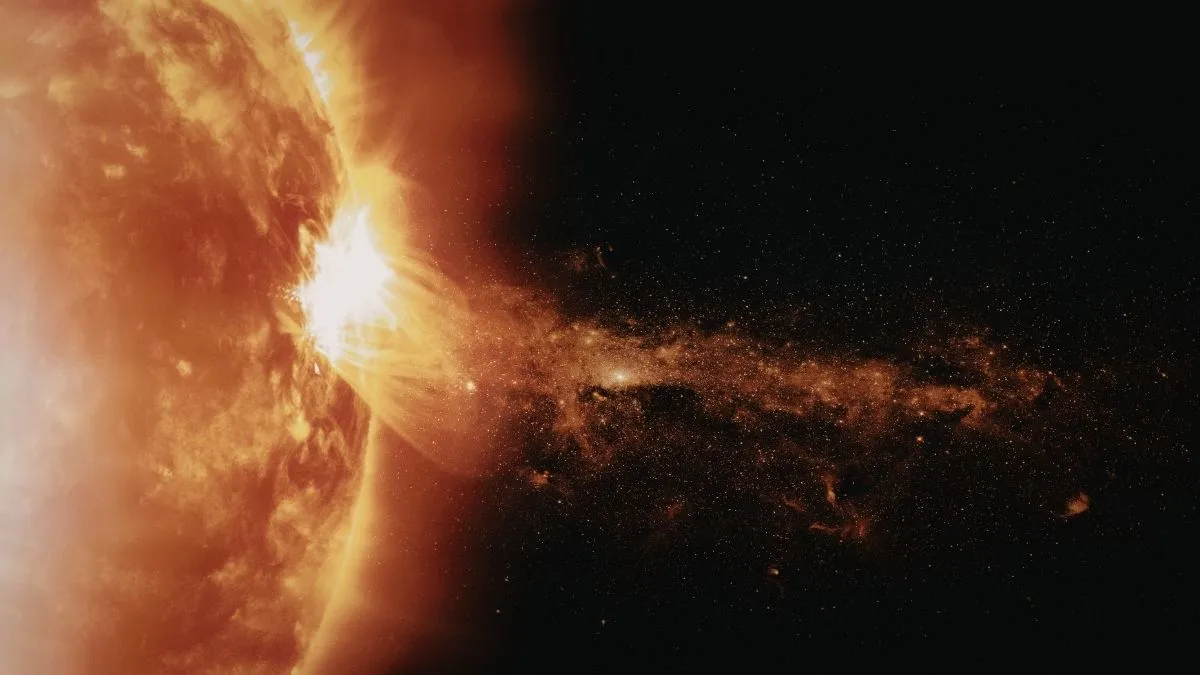
The sun has just released a powerful M5.7 solar flare, sending a stream of charged particles hurtling toward Earth’s atmosphere. This moderate to strong eruption originated from the active sunspot region AR4436 and peaked on May 10, 2026.
The blast also hurled out a fast-moving coronal mass ejection (CME) travelling at some 650 kilometers per second, the NOAA Space Weather Prediction Center (SWPC) said. While the bulk of the solar material is projected to pass behind Earth’s orbit, a glancing blow is anticipated by early May 13, 2026.
This solar activity has already triggered radio blackouts over the Atlantic and is now setting the stage for a potential solar flare northern lights display across high-latitude regions.
Will the Northern Lights be visible in the US?
Current modeling from NOAA and the U.K. Met Office suggests that the incoming CME will likely spark G1 (Minor) geomagnetic storm conditions. This level of activity, not as intense as the historic G5 storms of 2024, often pushes the aurora borealis further south than usual.
| Feature | Details of Solar Event |
| Flare Classification | M5.7 (Moderate-Strong) |
| Source Region | Sunspot AR4436 |
| CME Arrival Window | Early Wednesday, May 13, 2026 |
| Storm Intensity | G1 (Minor) Geomagnetic Storm |
| Potential Visibility | Northern Tier US States & Scotland |
States with the Best Solar Flare Northern Lights Viewing Chances
-
Washington and Idaho: Northern horizons may see a green glow.
-
Montana and North Dakota: Clear skies could offer vibrant displays.
-
Minnesota and Wisconsin: Higher latitudes are favored for sightings.
-
Michigan and Maine: Northernmost tips should remain on high alert.
Impact of the Coronal Mass Ejection and Solar Flare
The sun solar flare has already made its presence felt on Earth. As the M5.7 flare ionized the upper atmosphere, it caused a moderate (R2) radio blackout, disrupting high-frequency communications used by aviators and mariners.
Official Safety and Technical Briefing:
-
Radio Disruptions: High-frequency (HF) radio signals may continue to experience fading or total blackouts during further M-class eruptions.
-
Satellite Operations: Minor impacts on satellite orientation are possible during G1 storming.
-
Power Grids: Weak power grid fluctuations can occur in the extreme northern latitudes, but are generally not a cause for public concern.
"Sunspot region AR4436 is currently rotating into Earth's 'strike zone,'" noted NOAA officials. This means that any additional solar flare activity from this region in the coming days will be more directly aimed at our planet, potentially increasing the intensity of future aurora forecasts.
Also Read - India Dominates Global Heat Charts with 98 of 100 Hottest Cities Recorded Worldwide
As the sun approaches its solar maximum in 2026, events like this coronal mass ejection are becoming more frequent. While tonight remains relatively quiet, skywatchers should prepare for enhanced northern lights activity on Wednesday night. Stay tuned to official NOAA alerts for real-time updates on this evolving space weather story.
Enter your Blink text here...