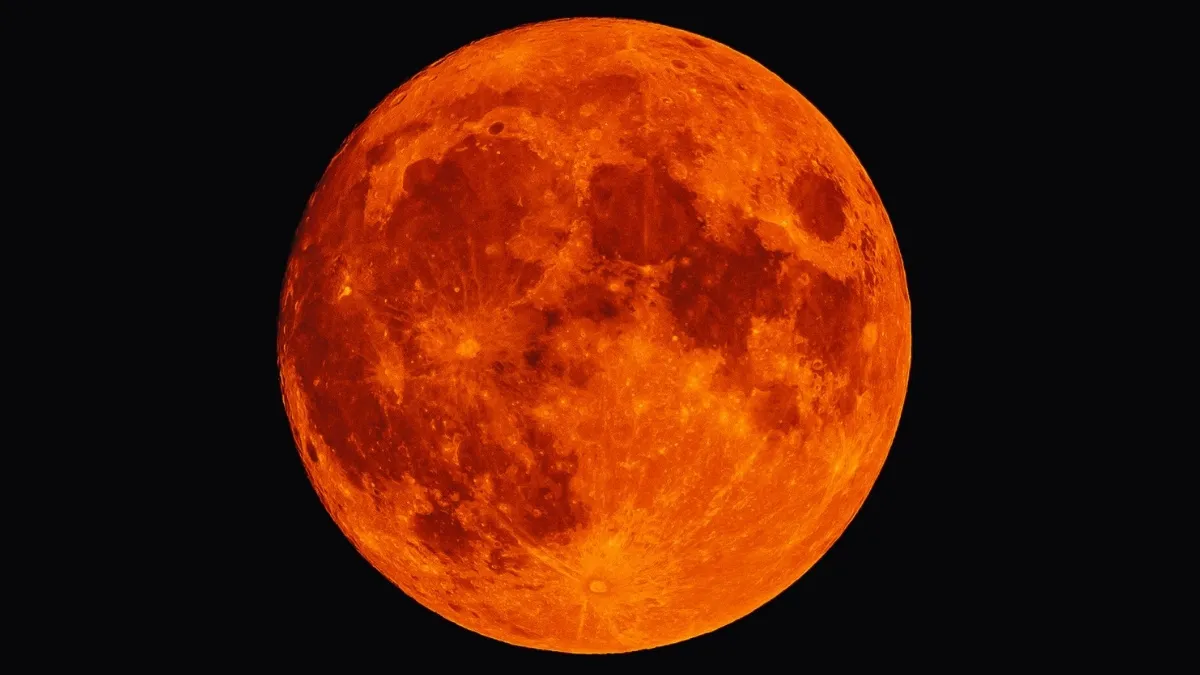
You might venture outside on an evening, and observe the Moon assuming an orange hue, even reddish, instead of a pale white. That is what is known as an orange Moon, whereby the Sun's light reflected by the Moon travels within Earth's atmosphere in just the right way.
According to NASA and major sky‑watching observatories, all the different colors have to do with how our atmosphere scatters light.
The Moon itself isn’t changing color. Astronauts on the Moon perceive it as gray‑white, while from our vantage point on Earth, the view of it subtly shifts toward other colors depending on its position in the sky and what’s floating in the air above us.
In this article you will learn why the Moon looks orange, what it means scientifically, how often it happens, and what the rarest Moon colors are.
Why is the Moon Orange Sometimes?
The Moon appears to take on an orange color when it is shining through a thick disk of the Earth’s atmosphere. This happens most often when the Moon appears near the horizon.
When the Moon appears near the horizon, the atmosphere scatters the blue and the green colors of the Moon’s light away from our eyes.
Thus, we are left to only see the red and the orange colors of the Moon. This same effect causes the sky to turn orange and red when we observe a sunset or a sunrise.
When the Moon escapes into a higher position in the sky, we see it as white or the color of yellow because, at this point, the atmosphere thins.
Main reasons the Moon turns orange
The Moon might turn orange for a specific reason. Read below the Main reasons the Moon turns orange:
-
A low-lying Moon means that its light has to travel through a thicker slice of the atmosphere, removing more of the blue and leaving it orange or reddish in color.
-
Airborne particles of dust, pollution, and smoke from forest fires scatter blue light even more, pushing the Moon’s color towards orange-red.
-
Weather conditions also come into play, as on muggy or hazy nights, water droplets and tiny particles in the atmosphere bend and filter the light, imparting a warmer color to the Moon.
Read about Why is the Moon Red Tonight in the U.S.?
What does an Orange Moon mean?
An orange-colored Moon has nothing to do with the supernatural or astrology; it’s simply a natural optical occurrence that happens when light interacts with the atmosphere.
There are colorful names for orange or red-colored moons, such as “Harvest Moon” or “Blood Moon,” but these are not scientific terms.
Scientifically, an orange Moon usually tells you that:
-
The Moon is near the horizon, or
-
There is extra dust, smoke, or haze in the air.
When the Moon enters its eclipse and turns orange, it often changes to a deep red or copper color.
This is because the sunlight goes around the Earth and passes through our atmosphere before illuminating the Moon.
This is why the Moon during an eclipse is sometimes called a “Blood Moon,” although it is actually just scattered sunlight.
Is it Rare to See an Orange Moon?
Seeing an orange Moon is not rare at all. It happens every time the Moon rises or sets, especially when the sky is clear enough to see it near the horizon.
However, how strongly orange it looks depends on conditions:
-
In very clean air, the Moon may only appear slightly warm‑colored.
-
In dusty, smoky, or polluted skies, the orange or red tint can be very vivid.
While the occurrence is quite common, the bright orange glow that draws attention usually makes its appearance during specific weather or seasonal events, such as wildfires, sandstorms, or when there is heavy haze.
What is the Rarest Moon Color?
Most of the time the Moon looks white, yellow, or orange‑red near the horizon. Under special conditions, however, it can appear in other unusual colors:
-
Deep red or copper: During a total lunar eclipse, when sunlight is filtered through Earth’s atmosphere.
-
Blue Moon: Very rarely, after major volcanic eruptions or large wildfires, fine particles in the air can scatter red light and make the Moon look faintly blue.
-
Green or turquoise edges: In rare atmospheric mirages, parts of the Moon’s edge may briefly look green, similar to the “green flash” sometimes seen with the Sun.
Of these phenomena, the blue color of the Moon caused by particles in the atmosphere is considered to be one of the rarest colors that can be observed in the Moon, and this is why the phrase “once in a blue Moon” has become so popular.
Know about Harvest Moon vs Hunter Moon in 2025 here.
Conclusion
An orange moon is simply what occurs when the sun’s light reflects off the moon and passes through the Earth’s atmosphere. The blue light is scattered, and the reds and oranges get to take center stage. It’s not an unusual or threatening or mystical phenomenon, but rather a beautiful and normal effect of light, atmosphere, and perspective that you can observe on any given evening when the moon is rising or setting.


-1769752113152.jpg)
-1769750813610.jpg)
Comments
All Comments (0)
Join the conversation