

Key Points
- KIIT has released the KIITEE 2026 syllabus and pattern today, December 1, 2025.
- Candidates can check the schedule on the official website at kiitee.kiit.ac.in.
- The first phase of exams is scheduled for April 16 to 20, 2026.
KIITEE 2026: The Kalinga Institute of Industrial Technology (KIIT) has released the Kalinga Institute of Industrial Technology Entrance Exam (KIITEE) 2026 exam syllabus and pattern today, December 1, 2025. Candidates who wish to appear for the exams will need to visit the official website to check the schedule at kiitee.kiit.ac.in. The institute has released the KIITEE 2026 exam dates, with the first phase of exams to be held between April 16 to 20, 2026.
KIITEE 2026 Key Highlights
Check the following table carrying the important details of KIITEE Exam 2026 here:
| Overview | Details |
| Event name | KIITEE 2026 Syllabus and Exam Pattern released |
| Exam name | Kalinga Institute of Industrial Technology Entrance Exam (KIITEE) |
| Board name | Kalinga Institute of Industrial Technology (KIIT) |
| Academic year | 2026-27 |
| Official website | kiitee.kiit.ac.in |
| Stream | Engineering |
| Exam mode | Online, Computer-based test (CBT) |
| Phase 1 exam dates | April 16 to 20, 2026 |
| No. of sections | 3 (Physics, Chemistry, Mathematics) |
| Language of exam | English |
| Exam Duration | 150 minutes |
| Number of questions | 120 |
| Total marks | 480 |
| Type of questions | MCQs |
| Marking scheme | Correct: +4 Incorrect: -1 |
KIITEE 2026 Exam Syllabus
Candidates can check the topic-wise KIITEE 2026 exam syllabus here:
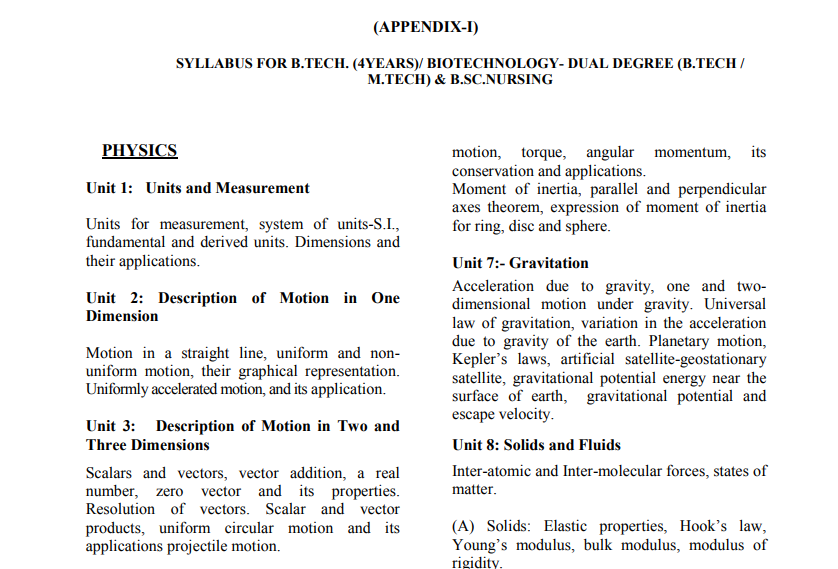
| Physics | Chemistry | Mathematics |
| Units and Measurement | Some Basic Concepts | Sets, Relations and Functions |
| Description of Motion in One Dimension | States of Matter | Complex Numbers |
| Description of Motion in Two and Three Dimensions | Atomic Structure | Matrices and Determinants |
| Laws of Motion | Solutions | Quadratic Equations |
| Work, Energy and Power | Chemical Energetics and Thermodynamics | Permutations and Combinations |
| Rotational Motion and Moment of Inertia | Chemical Equilibrium | Binomial Theorem and Its Applications |
| Gravitation | Redox Reactions and Electrochemistry | Sequences and Series |
| Solids and Fluids | Rates of Chemical Reactions and Chemical Kinetics | Differential Calculus |
| Oscillations | Surface Chemistry | Integral Calculus |
| Waves | Chemical Families Periodic Properties | Differential Equations |
| Heat and Thermodynamics | Chemical Bonding & Molecular Structure | Two-Dimensional Geometry |
| Transference of Heat | Chemistry of Non-Metals - 1 | Three-Dimensional Geometry |
| Electrostatics | Chemistry of Non-metals-II | Vector Algebra |
| Current Electricity | Chemistry of Lighter Metals | Measures of Central Tendency and Dispersion |
| Thermal and Chemical Effects of Currents | Heavy Metals | Probability |
| Magnetic Effects of Currents | Chemistry of Representative Elements | Trigonometry |
| Magneto Statics | Transition Metals Including Lanthanides | |
| Electromagnetic Induction and Alternating Currents | Coordination Chemistry and Organo Metallics | |
| Ray Optics | Nuclear Chemistry | |
| Wave Optics | Purification and Characterization of Organic Compounds | |
| Electromagnetic Waves | Some Basic Principles | |
| Electron and Photons | Hydrocarbons | |
| Atoms, Molecules and Nuclei | Organic Compound Containing Halogens | |
| Solids and Semi-Conductors Devices | Organic Compounds Containing Oxygen | |
| Organic Compounds Containing Nitrogen | ||
| Synthetic and Natural Polymers | ||
| Bio Molecules and Biological Processes | ||
| Chemistry In Action | ||
| Environmental Chemistry |


Comments
All Comments (0)
Join the conversation