PM Modi’s Uzbekistan Visit: Check Key Highlights–From Highest Civilian Honour To Uranium & Visa-Free Travel
PM Modi’s Uzbekistan visit brings a Comprehensive Strategic Partnership, uranium supply deal, trade and investment plans, AI, healthcare, education and more.
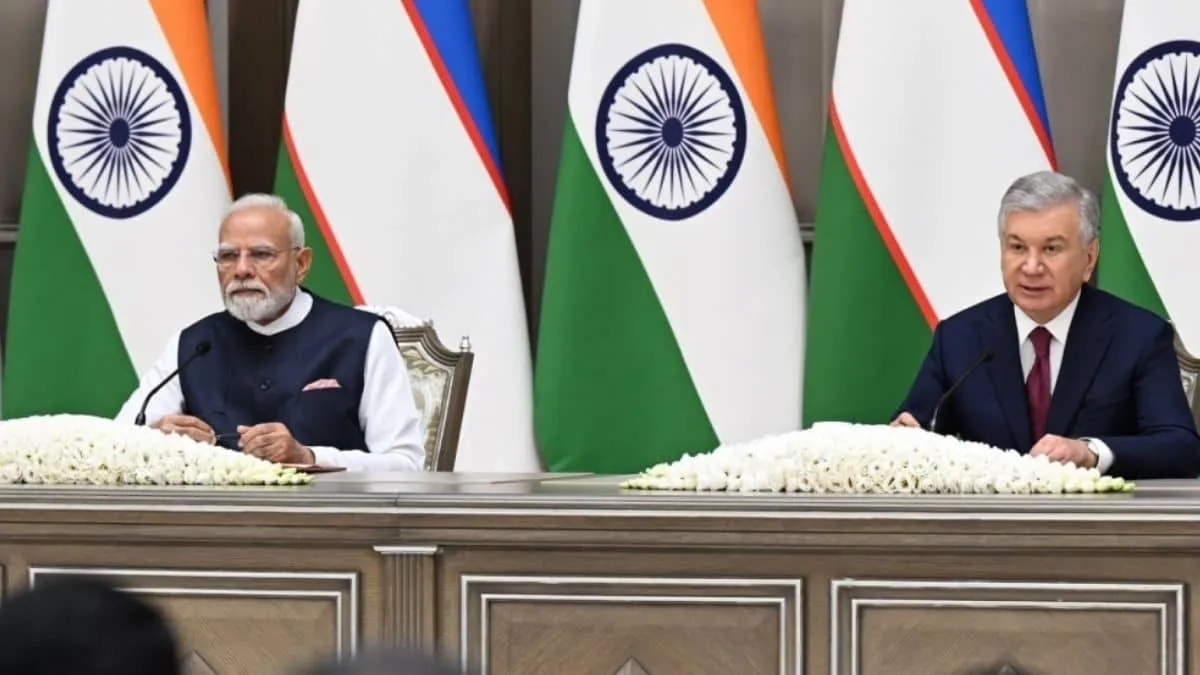
Prime Minister Narendra Modi's two-day visit to Uzbekistan on August 29 and 30, 2026, brought several important developments for India-Uzbekistan relations.
PM Modi met Uzbek President Shavkat Mirziyoyev in Tashkent, where the two leaders discussed trade, energy, defence, technology, education, healthcare and other areas of cooperation.
One of the biggest outcomes was the decision to take India-Uzbekistan relations to the level of a Comprehensive Strategic Partnership. PM Modi was also given one of Uzbekistan's highest state honours.
Uranium, critical minerals, AI, pharmaceuticals and even the restoration of an ancient Buddhist site were among the subjects that came up during the visit.
Here are the key points from the visit.
Key outcomes from today’s talks with President Shavkat Mirziyoyev in Tashkent include:
— Narendra Modi (@narendramodi) August 30, 2026
Elevation of India-Uzbekistan relations to a Comprehensive Strategic Partnership.
Boost trade to over 5 billion dollars by 2030.
Increase cooperation in infrastructure, DPI, AI, critical… pic.twitter.com/aSpqLm7iNt
PM Modi Gets Uzbekistan’s Top State Honour
PM Modi received the Order of Oliy Darajali Do‘stlik, a high state honour of Uzbekistan.
The honour was given in recognition of his contribution to strengthening relations between India and Uzbekistan.
PM Modi thanked the Uzbek leadership for the honour and dedicated it to the friendship between the people of the two countries.
The award came at a time when both countries are looking to expand their relationship into several new areas.
India-Uzbekistan Ties Get a New Name
India and Uzbekistan have decided to elevate their relationship to a Comprehensive Strategic Partnership.
The two countries already cooperate in a number of fields. The latest decision gives a wider framework to that cooperation.
Trade and investment will remain important, but the partnership will also cover energy, transport, digital technology, AI, cybersecurity, critical minerals, healthcare, education and space.
The two governments will also keep a closer watch on the implementation of agreements through a mechanism led by their foreign ministers.
Uranium Supply Is One of the Key Developments
The word uranium may stand out in the list of agreements.
India and Uzbekistan have agreed to work towards a long-term arrangement for uranium supply.
Uranium is used as fuel in nuclear power plants. For a country with an expanding nuclear energy programme, having dependable sources of nuclear fuel matters.
The two countries are not stopping at uranium. They will also explore cooperation in nuclear energy, mining, geology and critical minerals.
What Happened on the Visa-Free Entry Issue?
The visa issue needs to be looked at carefully.
The joint statement issued after PM Modi's visit does not announce a new blanket visa-free arrangement for ordinary Indian passport holders.
So, it would not be correct to say that Indians can now simply travel to Uzbekistan for 30 days without a visa because of this visit.
There are already different visa provisions for different categories of travellers, including certain transit arrangements. Anyone planning a trip should check the current Uzbek visa rules before travelling.
Trade Between India and Uzbekistan
Both countries want to increase trade and bring more products into their respective markets.
The leaders agreed to work on non-tariff barriers and investment-related difficulties that can make business harder.
A Joint Working Group will look into these issues.
There is particular scope for business cooperation in electrical goods, engineering products, automobiles and pharmaceuticals.
India and Uzbekistan also want more companies from both countries to invest in each other's markets. E-commerce and digital systems for trade are also part of the plan.
The two countries had earlier completed a joint feasibility study on a possible Preferential Trade Agreement. The relevant ministries have now been asked to examine the next steps.
Why Are Critical Minerals Being Discussed?
Critical minerals may not be as familiar as gold or petroleum, but they are becoming increasingly important.
They are needed for many modern industries and technologies.
India and Uzbekistan have agreed to look at joint work in geological exploration, mining, mineral processing and recycling.
The plan is not simply to take minerals out of the ground. Both countries are interested in developing value-added products and supply chains around them.
Indian companies may also take part in the development of mineral deposits in Uzbekistan.
AI and IT Cooperation
Artificial intelligence was also part of the discussions.
India and Uzbekistan want to share experience in developing AI systems that are safe, secure and trustworthy.
There is already an interesting India-Uzbekistan connection in the IT sector.
Tashkent's first IT Park was established in 2019 with the support of the Software Technology Parks of India, based on the Indian IT Park model.
The two countries now want to expand cooperation among technology parks, companies, start-ups and educational institutions.
Pharmaceuticals and Healthcare
Pharmaceuticals are another area where India and Uzbekistan see considerable potential.
The two countries agreed to increase cooperation in public health, biomedical research and medical innovation.
They also discussed the possibility of setting up more medical centres, laboratories and research institutions in Uzbekistan with Indian participation.
The Tashkent Pharma Park is expected to provide a platform for pharmaceutical manufacturing, investment and technology transfer.
For India, this also creates another opportunity for its pharmaceutical companies to expand their presence in Central Asia.
What About Students and Education?
Education has been a steady part of India-Uzbekistan relations.
The joint statement says that more than 2,700 Uzbek nationals have taken part in India's ITEC programme.
More than 400 Uzbek students have also been selected for ICCR scholarships, including scholarships under AYUSH.
India has now announced the Lal Bahadur Shastri Scholarship for Hindi Language in Uzbekistan.
The two countries also want universities and research institutions to work more closely. India studies in Uzbekistan and Uzbek studies in India are both expected to receive greater attention.
India to Help Restore the Aral Sea Region
A different kind of cooperation came up when the leaders discussed the environment.
India and Uzbekistan will work together on the greening and ecological rehabilitation of the Aral Sea region.
India will provide US$1 million, along with technical support, under its Grant-in-Aid framework.
The work will connect Uzbekistan's Yashil Makon initiative with India's Ek Ped Maa Ke Naam initiative.
The Aral Sea has faced serious environmental problems, so the project is aimed at supporting ecological restoration in the region.
Ancient Buddhist Sites Also Part of the Talks
The relationship between India and Uzbekistan has a much older history than today's diplomatic ties.
That history was visible in another agreement discussed during the visit.
India and Uzbekistan will cooperate on the preservation and restoration of the ancient Buddhist sites of Fayaz Tepe and Karatepa.
The two sides have signed a Letter of Intent relating to conservation and restoration work at these sites.
Modern methods, including digital technology and 3D models of archaeological objects, may also be used in preserving cultural heritage.
Tourism, Yoga and Culture
The two countries are also looking at ways to bring their people closer.
A Cultural Exchange Programme for 2026–2030 was welcomed during the visit. It will cover cultural events, festivals, exhibitions and other exchanges.
Tourism cooperation is also being strengthened through a programme covering 2026–2028.
Yoga has its own place in the relationship. The Yoga Federation of Uzbekistan and India's Ministry of AYUSH are cooperating on instructor training and promotion of yoga.
The two countries have also agreed to work together in traditional medicine.
Defence Cooperation Continues
India and Uzbekistan already conduct military cooperation, including the Dustlik joint military exercise.
The latest edition mentioned in the joint statement took place in Uzbekistan's Namangan Region in April 2026.
The two countries want to continue this cooperation and explore new areas in the defence sector.
Security discussions also covered terrorism, organised crime, drug trafficking and cyber threats.
India and Uzbekistan to Work Together in Space
The two countries are also looking beyond Earth.
India and Uzbekistan have agreed to expand cooperation in the peaceful uses of outer space.
This could include sharing scientific data, space applications, training and joint workshops.
Uzbekistan Backs India’s Permanent UNSC Membership
There was an important development on the diplomatic front as well.
Uzbekistan reaffirmed its support for India's candidature for permanent membership of the UN Security Council.
Both countries called for reforms of the Security Council so that it becomes more representative of the present world.
India and Uzbekistan will also continue working together through the United Nations, the Shanghai Cooperation Organisation and other international forums.
PM Modi’s Uzbekistan Visit: Key Points at a Glance
| Key Points | What happened |
| India-Uzbekistan ties | Elevated to a Comprehensive Strategic Partnership |
| Honour for PM Modi | Order of Oliy Darajali Do‘stlik |
| Uranium | Long-term supply arrangement |
| Trade | Efforts to increase and diversify bilateral trade |
| Critical minerals | Cooperation in exploration, mining and processing |
| AI | Cooperation on safe and trustworthy AI |
| IT | Greater cooperation between IT parks, companies and start-ups |
| Healthcare | Medical research and pharmaceutical cooperation |
| Education | Scholarships and research cooperation |
| Aral Sea | India to provide US$1 million for rehabilitation efforts |
| Culture | Cultural Exchange Programme for 2026–2030 |
| Tourism | Tourism cooperation programme for 2026–2028 |
| Heritage | Conservation of Fayaz Tepe and Karatepa |
| Defence | Continued military and security cooperation |
| Space | Peaceful space cooperation |
| UN | Uzbekistan supports India's permanent UNSC membership |
What Does the Visit Mean for India?
The significance of this visit lies in the number of areas covered by the two countries.
Uranium and critical minerals are important from the energy and resource point of view. Pharmaceuticals and healthcare offer opportunities for Indian companies. IT and AI open another area for cooperation.
At the same time, education, tourism, yoga and cultural exchanges are keeping the people-to-people connection alive.
Uzbekistan is also an important country for India in Central Asia. Building stronger relations with Tashkent can help India deepen its engagement with the region.
For Uzbekistan, closer cooperation with India can bring investment and expertise in sectors such as pharmaceuticals, information technology, healthcare and education.
The decision to establish a Comprehensive Strategic Partnership brings all these areas together.
So, PM Modi's Uzbekistan visit was not centred around just one agreement. It was a broader attempt by both countries to expand a relationship that already has strong historical and cultural roots.
One Point to Remember
A number of developments came out of the visit, but a blanket 30-day visa-free entry for ordinary Indian passport holders was not announced in the joint statement provided for this visit.
That distinction is important, particularly for travellers looking for information about visiting Uzbekistan.
The more significant long-term story from the visit is the widening of India-Uzbekistan cooperation from uranium and minerals to AI, medicines, education, culture and space.
Prabhat Mishra is a Subject Matter Expert and digital journalist with an extensive background in the competitive exam landscape and over 4 years of experience in education, national and international news, and current affairs. Over his tenure with top knowledge platforms like Mentorship India, IAS BABA, IAS SARTHI, and now Jagran Josh, he has a deep understanding of government exams like UPSC and State PCS, including UP and Bihar, as he has already qualified for the UPPCS 2022 Mains and Bihar 68th Mains. With his core expertise in history, polity, geography & current affairs, he specialises in creating well-researched, aspirant-centric content and simplifying complex topics for competitive examinations.


![[Out] UGC NET June 2026 Result Live: यूजीसी नेट रिजल्ट ugcnet.nta.nic.in जारी, डायरेक्ट लिंक से करें चेक](https://img.jagranjosh.com/images/2026/August/2782026/UGC-NET-Result-2026-Marksheet-link-pdf.jpg)