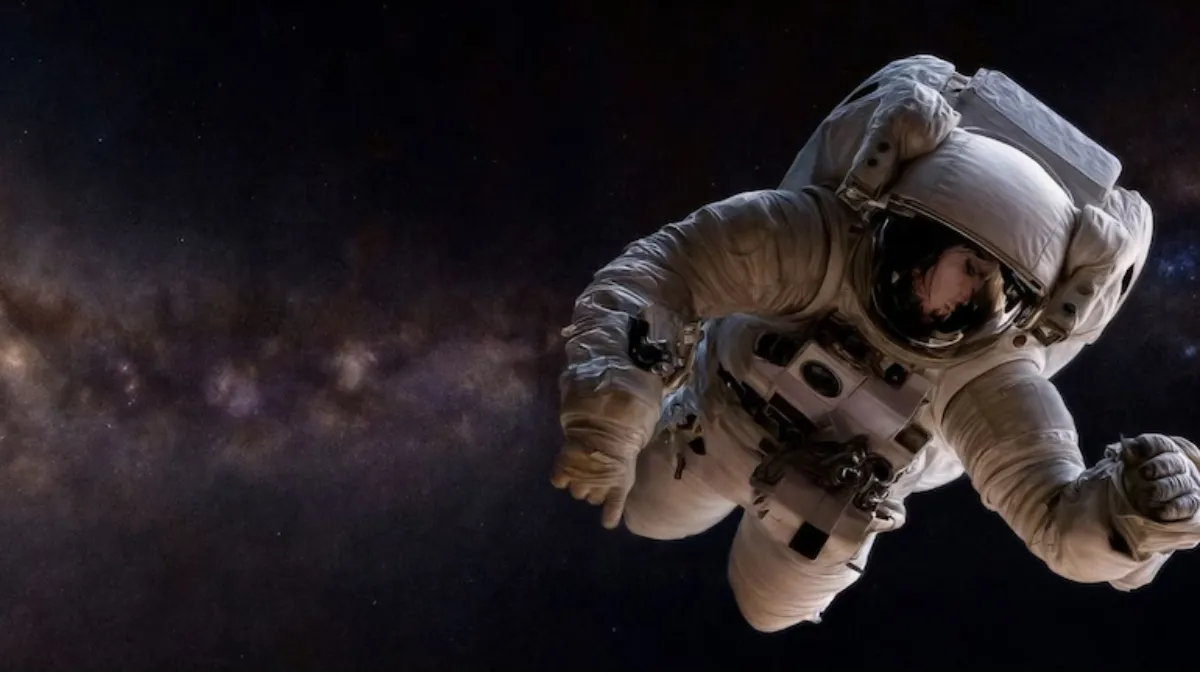
NASA astronauts in the International Space Station (ISS) will perform the first extra-vehicle activity (EVA) or spacewalk of 2026 on January 8, which will be a major milestone in the maintenance of the orbital laboratory.
At 8 a.m. EST (6.30 p.m. IST), the Quest spacecraft will see the departure of Expedition 74 Commander Mike Fincke and Flight Engineer Zena Cardman in a planned 6.5 hour spacewalk, the U.S. EVA 94. This is after the EVA preparations, such as spacesuit checking and review of procedures with crewmates.
The second U.S. EVA, U.S. EVA 95 will occur on January 15 to resume similar activities.
Spacewalk Objectives
Majorly, the attention is on the power system upgrade of the ISS to allow new roll-out solar arrays (iROSA). Specific tasks include:
-
Fitting a modification kit on the truss structure on the station on the port side.
-
Installation of routing cables to allow future attaching iROSA on the 2A power channel to increase total power capacity available to experiments and de-orbital activities.
Performing Hardware Check and Photography
-
Microbial swabbing of five external locations around the airlock would be done in order to understand long-duration mission potential contamination risks.
-
The final stage in the list of ISS power upgrades is associated with these upgrades, which would help maintain the station until its intended retirement in 2030.
Check Out: SIR Online Form: Official Website Link, Process and FAQs You Need to Know
Crew Roles and Preparation
The leader of Expedition 74, starting December 9, 2025, and lasting until July 2026, is Fincke, a member of the crew who has made 10 spacewalks in his career. On her first EVA, Cardman is an expert in the field of geology.
NASA astronaut Chris Williams and JAXA astronaut Kimiya Yui will be used to control airlock activities, check vital signs and control robotics on the inside.
The last preparations included checking of SAFER jetpacks to carry out untethered operations, safety inspection, and maneuver training.
The crew also used prep intervals to improve research in life sciences, such as growing protein crystals and maintenance of oxygen generators.
Expedition 74 Overview
This is the international crew of seven, which carries out the microgravity research studies in the fields of biology, human physiology, physics and materials science.
Major current projects are the Pharmaceutical In-Space Laboratory and development of medicine and brain circulation research. The 278th and 279th U.S. spacewalks overall belong to the Expedition 74 to support ISS assembly and maintenance and upgrades.
How to Watch Live?
NASA also covers it thoroughly:
-
Live at 6:30 a. m. EST (5 p.m. IST) on NASA+, YouTube, NASA TV (through apps and websites), and Amazon Prime Video.
-
Previews: The managers have talked about EVAs on X/Twitter and YouTube this week.
-
More sources: NASA blogs, animations (such as U.S. Spacewalk 94 preview on Instagram), and updates in real-time with the help of the hashtag of the anonym (e.g., @NASA and @Space_Station).
The HD video is covered by helicopters equipped with helmet cameras, external views of the ISS and the audio of the Mission Control.
Such regular EVAs maintain the structural integrity of the ISS against micrometeorites and thermal expansion as well as allow power redundancy which is important to science payloads.
Microbial sampling provides information about planetary protection measures by future Artemis and Mars missions. The iROSA arrays that should be installed through future cargo missions will increase efficiency by 20-30 per cent panel.
Check Out: Who Was the First King to Unite North and South India?




-1767891137509.jpg)
-1767882938552.png)
Comments
All Comments (0)
Join the conversation