Iceman of India: How This Ladakhi Engineer Built ‘Artificial Glaciers’ to Save His Village
Chewang Norphel, the "Iceman of India", solved Ladakh’s severe water crisis by building 15 artificial glaciers. By diverting winter runoff to lower altitudes, his simple, gravity-powered engineering provides vital spring water, transforming the lives of thousands of mountain farmers.

Key Points
- Civil engineer Chewang Norphel joined J&K in 1960, addressing Ladakh's water crisis.
- Norphel engineered artificial glaciers at 13,000 ft to melt for April/May planting.
- He built 15 artificial glaciers, receiving the prestigious Padma Shri award in 2015.
If you look at the map of India, you’ll see the state of Jammu and Kashmir at the top, but if you shift your eyes to the east of J&K, you’ll see the recently established Union Territory of India: Ladakh, or the Land of High Passes.
Ladakh is a scenic and mesmerising region, situated in the northernmost part of the Indian subcontinent. It has a cold desert climate. Despite being surrounded by 40% of massive glaciers, it still faces a worsening water scarcity crisis.
As mentioned above, Ladakh is a cold desert which has a semi-arid climate, and it mostly depends on the melting of glaciers. To put it simply, during winters, the snowfall replenishes the glaciers in the mountains, and when summer comes, these glaciers melt down and feed the streams, rivers and groundwater.
However, owing to the warming effects of climate change, these natural glaciers are melting very quickly. Further, Ladakh has been receiving erratic winter snowfalls. Absence of winter snows causes streams to dry out before spring, thus depriving the farmers of water in the April/May planting period.
How did the ‘Iceman of Ladakh’ solve this water crisis?
Ladakh has given us some of the most influential scientists and engineers of all time. One of them was Chewang Norphel.
For most of us, he is just a simple man from Ladakh, but for locals, he is the ‘Iceman of Ladakh’ who transformed the agricultural scenario and daily lives of Ladakhi people. How? Let’s dive in!
Who is Chewang Norphel?
Chewang Norphel is an Indian civil engineer who was born in the year 1935. He completed a diploma course in civil engineering from Lucknow in 1960. In June 1960, Norphel joined the rural development department of Jammu and Kashmir in Ladakh as a civil engineer.
i. The Story of Iceman of Ladakh/India
Chewang was a young civil engineer who joined the rural development department of Jammu and Kashmir in Ladakh. At that time, Ladakh was a part of the J&K state. While residing in Ladakh, he witnessed a major problem. People are abandoning their ancestral homes and moving to urban areas.
The reason, you may ask? They were forced to migrate. By whom? By the earth. Because the farming land could no longer feed them. The effects of global warming were clearly seen in Ladakh with the unusual melting and freezing of the natural glaciers.
To the rest of the world, Ladakh was a peaceful place to settle, with houses surrounded by the snow-capped peaks. However, for the farmers, it wasn’t the same case. It was a battleground for them. 80% of them depended entirely on water, which comes from the melting of glaciers, feeding their precious fields of barley and wheat.
ii. The Cruel Paradox:
However, every year in the spring season, there was a hard task. These were the months of April and May when the preparation of soil and planting took place, but there was no water and the land was dry. Glaciers that had been created naturally at a height of 18,000 feet were frozen owing to the freezing winter. Water could not flow until the month of June.
which was late in comparison to the time when seeds should be planted. On the contrary, in the middle of the winter season, fresh water flowed in plenty all through the valley from natural sources located in the mountain ranges but it was wasted in vain and eventually froze in the rivers. This problem disturbed Norphel, who was a young civil engineer working in the rural development department.
iii. The Leaking Tap
Norphel didn’t give up. He just needed a star or a spark. One winter morning, Norphel walked out into his garden in Leh. He noticed that a garden tap had been left dripping.
He saw that the dripping water, instead of flowing away, froze right on the poplar trees. This happened because the water moved very slowly, and the ground was always in the cold shade.
Norphel stared at the patch of ice. Why did the water freeze here? He wondered. The answer was actually pretty simple: speed and shade.
The wild mountain streams rushed down the steep slopes too fast to freeze, eventually just draining out of the valley. But this tap water was different. It was slow, shallow, and hidden in the cold shade away from the sun.
That’s when a wild idea hit him: What if I slow down the winter water and guide it into the shadows? Can I build my very own glacier?
iv. Engineering the Impossible
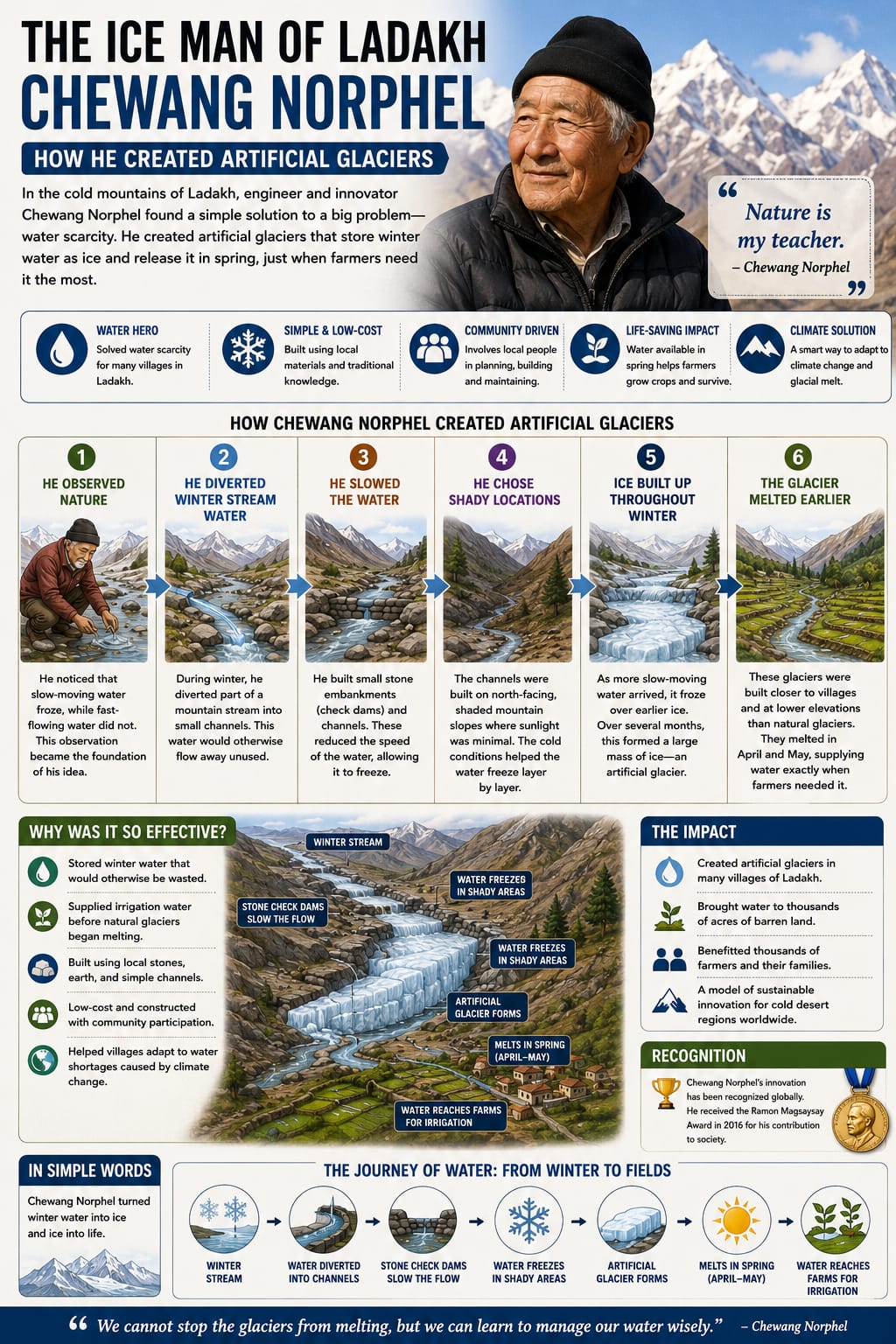
But Norphel knew if he constructed the glaciers at the lower altitude of 13,000 feet instead of the naturally occurring altitude of 18,000 feet, then the process of melting them would begin quite soon. This would occur in the month of April, just when the farmers needed water for planting their crops.
Thus, he gathered together a few sceptical but desperate villagers and started working. The following were the processes through which the glaciers were formed:
- Re-routing the Water: Using simple techniques and manual labour, they re-routed the water that flowed in the winters from the swift-flowing streams.
- Creation of Basins: This water was led into step-basins built in the colder and more shady slopes of the mountains.
- Slowly Making it Move: The stones created a sort of speed breaker, whereby when the fast-moving water reached this point, it slowed down and formed sheets of water.
- Frosting the Sheets: Due to the freezing temperatures of winter, this sheet of water froze quickly. One after the other, such glaciers were created to make huge man-made glaciers.
vThe Miracle of Phuktsey
The real test came in the spring. Under the warm beams of the April sun, the people of the village of Phuktsey waited with bated breath. Naturally formed glaciers located on the mountains were still frozen. But the artificial glacier created by Norphel at the height of 13,000 feet began to melt.
In no time, the stream turned out to be a large amount of water that went into the canals of the village. For the first time ever, there was sufficient water for sowing seeds. The largest glacier made by Norphel in the village of Phuktsey was 1,000 feet long and 150 feet wide.
Conclusion: His Legacy
With time, Norphel created as many as 15 such artificial glaciers in the cold desert. He created the largest one in the village of Phuktsey, which was an enormous structure of 1,000 feet in length and 150 feet in width. One glacier alone was enough to save the entire village of 700 people, because it gave them sufficient water.
Apart from giving water to the crops, the glaciers went inside the earth to replenish the underground water sources, thereby reviving the dried-up mountain springs.
The simple but effective engineering that saved the lives of thousands of mountain farmers earned Chewang Norphel the title of "Iceman of India". For his outstanding efforts, he received the Padma Shri award, one of the most prestigious awards in India, in the year 2015.

Kriti Barua is a skilled digital journalist and communications professional with 4+ years of experience, currently writing for the General Knowledge section at Jagran New Media. She has established herself as a subject matter expert in History, Geography, Trending National and International News, Sports, Science, and Defence, producing clear, reliable, and search-optimised content that connects with readers worldwide.
Kriti holds a BA degree from Delhi University and a one-year diploma in TV Production and Journalism, an academic background that adds research depth and strong storytelling instincts to her writing. Her experience spans brand writing, content marketing, and digital media, giving her a sharp understanding of what makes content both helpful to readers and visible in search.
At Jagran New Media, she applies this expertise to national and international news coverage, query-based articles, and in-depth pieces across her specialist subject areas. Her content is defined by easy language, factual accuracy, strong keyword strategy, and reader-friendly storytelling.

-(1)-1784277718367_t.webp)