Key Points
- Top 250,000 JEE Main scorers can register for JEE Advanced 2026.
- NTA sets qualifying cutoff (percentile) for JEE Advanced after final session.
- JEE Advanced 2026 has age limits; check criteria before applying.
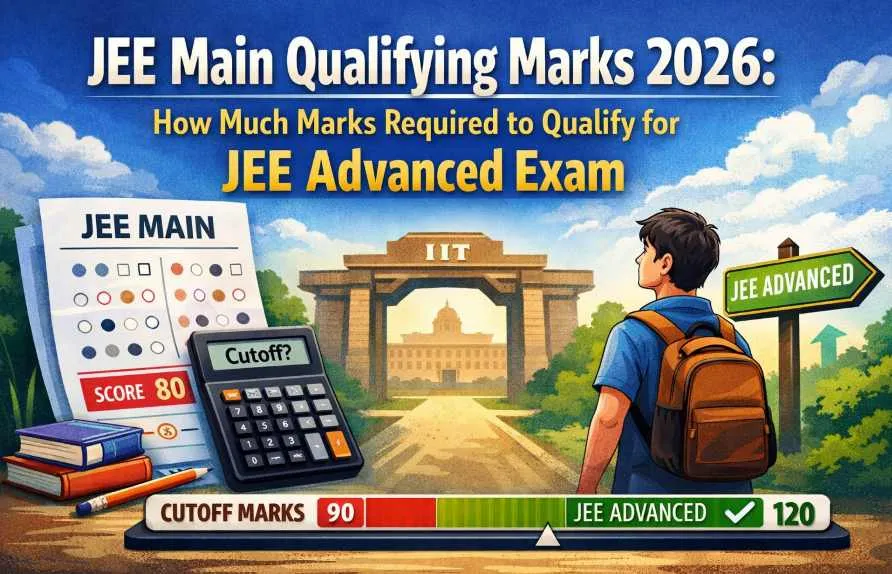
The Joint Entrance Examination (JEE) Main is the first step toward getting into the prestigious Indian Institutes of Technology (IITs). Think of it like a preliminary round. To move on to the final round—the JEE Advanced exam—you need to score at least a certain minimum mark or percentile in JEE Main. This minimum score is called the 'qualifying cutoff'. The National Testing Agency (NTA), which conducts the exam, sets different cutoff scores for different groups of students (like General, OBC, SC, ST, and EWS). Only the top 2,50,000 students across all categories who meet or exceed their respective cutoff scores are allowed to register and sit for the JEE Advanced exam.
It's important to understand that the 'qualifying cutoff' for JEE Advanced is not the same as the 'admission cutoff' for NITs or other colleges. The qualifying cutoff is simply the ticket to take the next exam (JEE Advanced). The actual marks needed for the qualifying cutoff change every year depending on how many students take the exam and how difficult the paper was. Generally, the cutoff percentile for the General category is the highest, while it is lower for reserved categories. We will analyze the expected percentile and corresponding marks you might need this year to ensure you make it into this crucial top group.
Check: JEE Advanced 2026 Syllabus PDF Download
JEE Main Marks Required for JEE Advanced 2026
The NTA acts as the initial gatekeeper for JEE Main, setting the official Qualifying Cutoff as an NTA Score (Percentile), not raw marks, which is announced after the final session.
The Joint Admission Board (JAB), along with the Organizing IIT (anticipated to be IIT Roorkee for 2026), is the ultimate regulator. They set the definitive eligibility criteria for JEE Advanced, ensuring that approximately 2,50,000 unique, category-wise shortlisted candidates qualify to compete for the prestigious IIT seats.
Estimated JEE Main 2026 Qualifying Cutoff
Based on historical trends and expected competition, the table below provides the estimated minimum percentile (NTA Score) and corresponding raw marks out of 300 required to qualify for JEE Advanced 2026 across different categories.
Category | Expected JEE Main 2026 Cutoff (Percentile) | Estimated Marks (Out of 300) |
| General (UR) | 93.5 – 95.0 | 100 – 110 |
| Gen-EWS | 81.5 – 83.5 | 80 – 85 |
| OBC-NCL | 80.0 – 82.0 | 75 – 82 |
| Scheduled Caste (SC) | 62.0 – 65.0 | 50 – 55 |
| Scheduled Tribe (ST) | 48.0 – 51.0 | 40 – 45 |
| PwD (All Categories) | 0.001 – 0.010 | 1 – 5 |
JEE Main Cut-off Trends
The following table illustrates the year-on-year shift in the JEE Main qualifying percentile (NTA Score) across different categories. Analyzing these historical figures is crucial for predicting the competitive benchmark for JEE Advanced 2026.

JEE Advanced Eligibility Criteria 2026
Shortlisting via JEE Main is only the first step. To sit for the JEE Advanced, candidates must satisfy the following five definitive criteria established by the Joint Admission Board (JAB):
-
Performance in JEE Main: The candidate must be among the top 2,50,000 successful candidates (category-wise) who have qualified in Paper 1 (B.E./B.Tech.) of JEE Main 2026.
-
Number of Attempts: A candidate can attempt the JEE Advanced examination a maximum of two times in two consecutive years. (E.g., if the first attempt is in 2025, the second and final attempt must be in 2026).
-
Appearance in Class 12 (or equivalent): The candidate must have appeared for the Class 12 (or equivalent examination) for the first time in either 2025 or 2026. Candidates who passed Class 12 in 2024 or earlier are ineligible.
-
IIT Admission History: The candidate should not have been admitted to any Indian Institute of Technology (IIT) previously, regardless of whether they continued the course or accepted the seat.
-
Subject Requirement in Class 12: The candidate must have taken the following five subjects in Class 12: Physics, Chemistry, Mathematics, a language, and any subject other than the above four.
JEE Advanced Age Limit 2026
The age criteria are strictly enforced to ensure a level playing field.
-
General/OBC-NCL/Gen-EWS: Candidates must have been born on or after October 1, 2001.
-
SC, ST, and PwD Categories: A 5-year age relaxation is provided. Candidates from these reserved categories must have been born on or after October 1, 1996.
The age limit serves as a critical filter. The organizing IIT fixes the exact birth-date requirement, including specific relaxation provisions for reserved categories. Students must verify this condition meticulously before planning their attempts, as eligibility for JEE Advanced registration is strictly conditional upon meeting this age criterion, irrespective of the JEE Main score.


-1768389502204.jpg)

Comments
All Comments (0)
Join the conversation